
Hyperliquid Staking Explained: How to Stake HYPE, ~2–2.5% APY, Validator Selection, Fee Discount Tiers & Kinetiq kHYPE (2026)
Hyperliquid staking guide: earn ~2–2.5% APY and cut trading fees up to 40% by staking HYPE. Validators, 7-day unstaking, fee tiers, Kinetiq kHYPE and risks.
Hyperliquid staking lets you earn roughly 2–2.5% APY paid in HYPE and unlock trading fee discounts of 5% to 40%, simply by delegating HYPE to a validator. Staking takes one click in the app, has a 1-day lockup, and a 7-day unbonding period when you leave. If you want to stay liquid, Kinetiq's kHYPE liquid staking token earns the same yield while staying usable across HyperEVM. As of September 2026, well over 40% of circulating HYPE is staked. Our guide walks you through the process, the validator choice, the fee tiers, Kinetiq, the risks, and how staking compares with HLP, so you pick the route that pays you most.
Key takeaways
- You earn ~2–2.5% APY in HYPE, set by protocol emissions; it drifts lower as more HYPE is staked.
- You save far more on fees than you earn in yield if you trade: fee discounts are the real prize, with 10 HYPE staked giving 5% off, 1,000 giving 10%, 10,000 giving 15%, 500,000 giving 40%.
- You can get out within about a week: lockups are 1 day after staking and 7 days to unstake.
- Your principal faces no slashing as of September 2026, so the main risk is validator downtime and HYPE price.
- You can stay liquid with Kinetiq kHYPE, the leading liquid staking option, composable across HyperEVM.
- Choose by risk appetite, staking vs HLP: staking is lower risk and lower yield; HLP is USDC-denominated market-making yield with real drawdowns.
What Hyperliquid staking is and why it exists
When you stake, you are paid for helping secure the chain you trade on. Hyperliquid runs on HyperBFT, a proof-of-stake consensus derived from HotStuff; validators propose and confirm blocks, and their voting power is proportional to the HYPE staked with them. When you stake, you are delegating your HYPE to a validator, adding to its weight and sharing in the rewards the protocol pays for securing the chain.
Staking serves three purposes for the network:
- Security. The more HYPE staked across honest validators, the more expensive an attack becomes. The validator set is small (roughly 16–24 active validators, with two-thirds of stake needed for consensus and bridge signatures), so distributing stake matters.
- Supply sink. Staked HYPE is locked for at least 8 days end to end, which reduces liquid supply and lines up with the Assistance Fund's buybacks; see Hyperliquid HYPE token for the full tokenomics.
- Fee alignment. The staking discount tiers reward committed holders with cheaper trading, which ties the token to the exchange's core business.
Everything happens on HyperCore, so staking, delegating and claiming rewards are gas-free signed actions, not smart-contract transactions.
Hyperliquid staking APY and how rewards are calculated
You earn approximately 2 to 2.5% per year in HYPE from native staking as of September 2026. The protocol targets an emission rate loosely modelled on other proof-of-stake chains, where the yield is inversely related to the fraction of supply staked: the more HYPE is delegated, the lower the per-token rate. Rewards accrue continuously per block and appear in your staking balance; they are not auto-compounded, but restaking is a single click.
Two things frame how you should think about this number:
- The yield is in HYPE, not dollars. If HYPE is up 30% on the year, your staking return is a rounding error next to price. If HYPE is down 40%, staking does not save you.
- The yield is not the whole return. For an active trader, the fee discount is worth far more than 2% on the staked amount. A trader doing $10M a month at base taker fees pays $4,500/month; a 10% Gold discount saves $450/month, or $5,400/year, which on 1,000 HYPE at ~$40 is a 13.5% "yield" from the discount alone.
Nothing here is guaranteed. Emission parameters can change through governance, and the APY figure in the app updates as staking participation moves.
Hyperliquid fee tiers from staking
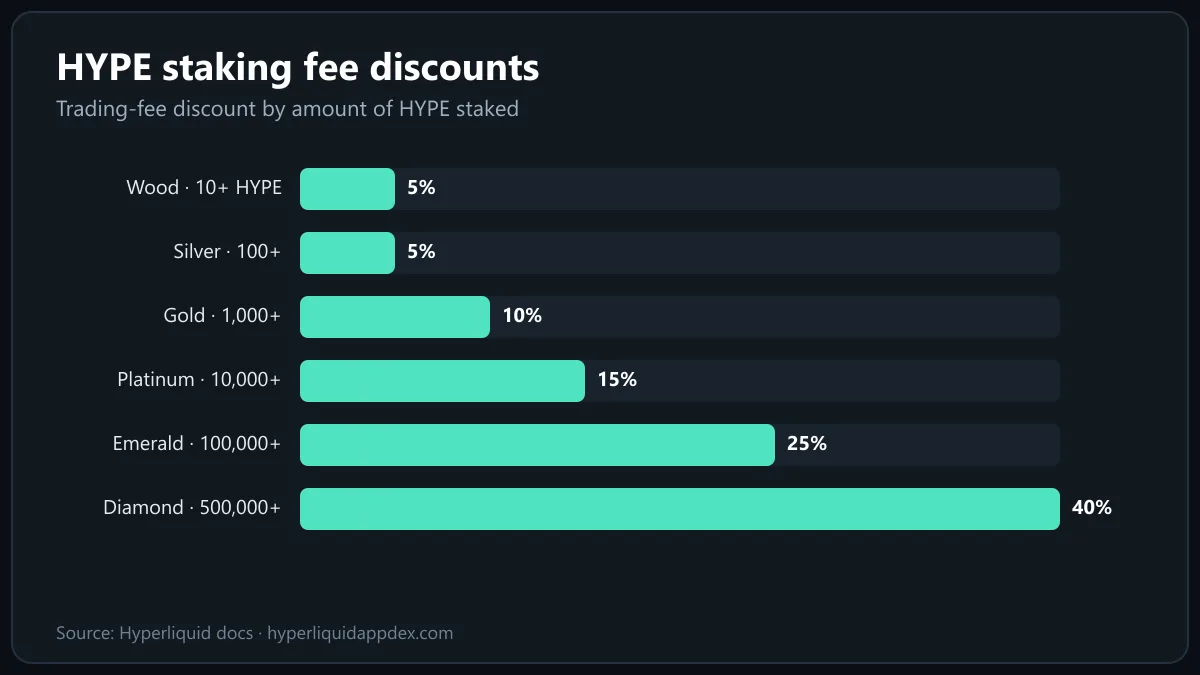
You can stack the staking discount on top of the volume-based VIP tiers and the 4% referral discount, multiplied together. If you have not applied a Hyperliquid referral code yet, do it before your first trade so the 4% stacks from day one. Here are the Hyperliquid fee tiers for staking as of September 2026:
| Tier | HYPE staked (14-day min) | Fee discount | Effective base taker fee | Effective base maker fee |
|---|---|---|---|---|
| None | 0–9 | 0% | 0.045% | 0.015% |
| Wood | 10+ | 5% | 0.04275% | 0.01425% |
| Silver | 100+ | 5% | 0.04275% | 0.01425% |
| Gold | 1,000+ | 10% | 0.0405% | 0.0135% |
| Platinum | 10,000+ | 15% | 0.03825% | 0.01275% |
| Emerald | 100,000+ | 25% | 0.03375% | 0.01125% |
| Diamond | 500,000+ | 40% | 0.027% | 0.009% |
Worked example: a trader with $50M+ 14-day volume (VIP tier: 0.040% taker), Gold staking (10% off) and a referral code (4% off) pays 0.040% × 0.90 × 0.96 = 0.03456% taker. Full details, including the VIP volume tiers and spot fees, are in the Hyperliquid trading fees guide.
The discount uses your minimum staked balance over the trailing 14 days, so staking 1,000 HYPE today will not give you Gold pricing until two weeks of history have accumulated. Plan ahead if you are staking for the discount.
How to stake HYPE on Hyperliquid step by step
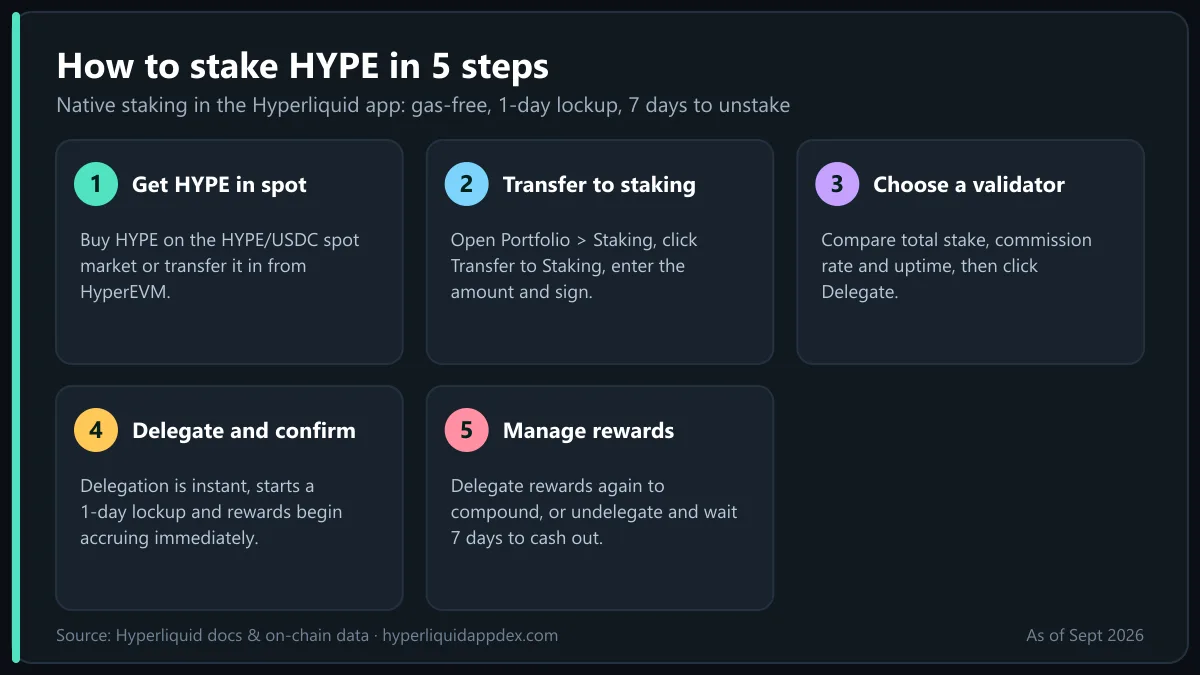
You can complete the native staking flow in the Hyperliquid app in under five minutes:
Step 1: Get HYPE in your spot balance
Buy HYPE on the Hyperliquid spot market (HYPE/USDC) using bridged USDC, or transfer HYPE in from HyperEVM. If you are starting from scratch, see how to buy Hyperliquid and the Hyperliquid bridge guide.
👉 Open the Hyperliquid app and save 4% on fees
SIXPROSPERStep 2: Transfer to the staking balance
Open Portfolio > Staking (or the Staking tab in the top navigation). Click Transfer to Staking, enter the amount of HYPE, and sign. This moves HYPE from your spot account into a staking account; it is not yet delegated.
Step 3: Choose a validator
The validator list shows each validator's name, total stake, commission rate, uptime and whether it is active. Click Delegate on the one you choose (validator selection tips below).
Step 4: Delegate and confirm
Enter the amount to delegate and sign. Delegation is instant, but it triggers a 1-day lockup during which you cannot undelegate. Rewards begin accruing immediately.
Step 5: Manage rewards
Rewards accumulate in your staking balance. To compound, delegate them again. To cash out, undelegate, wait 7 days, then transfer to spot. Your staking tier for fee purposes is based on total delegated HYPE, so restaking rewards nudges you toward the next tier over time.
How to unstake HYPE and the 7-day unbonding period
Plan your exit a week ahead, because unstaking is a two-step process:
- Undelegate from the validator. Available after the 1-day post-staking lockup. The HYPE returns to your staking balance and stops earning.
- Transfer from staking to spot. This is where the 7-day unbonding period applies. The transfer is queued and completes seven days later.
During those seven days your HYPE is not tradable, cannot be used as collateral, and is still exposed to price. If you think you may need to sell quickly, either keep a portion unstaked or use kHYPE, which can be sold on secondary markets instead of waiting.
The term "Hyperliquid unlock" often gets tangled up with staking in search. Two different things: the 7-day staking unlock described here, and the token unlock schedule for core contributors (~23.8% of supply, one-year lock, vesting from 2027–2028 onward). The latter is covered in the HYPE tokenomics guide; it has nothing to do with your staking withdrawals.
Hyperliquid validators: how to choose one
You cannot lose your stake to a bad validator while slashing is not live, so selection is mostly about uptime, commission and decentralisation. Points to weigh:
- Uptime. A validator that misses blocks earns less for you. Stick to validators showing 99%+ uptime over 30 days.
- Commission. Most Hyperliquid validators charge between 0% and 10%. A 5% commission on a 2.3% yield costs you about 0.12% a year; not nothing, but not a reason to pick an unreliable operator.
- Stake concentration. The Hyper Foundation validators historically held a large share of stake, which is one of the recurring centralisation critiques (see our Hyperliquid safety guide). Delegating to well-run non-foundation validators (Kinetiq's set, Nansen, Chorus One, B-Harvest, ValiDAO, Hypurr Collective and similar) helps decentralise the network.
- Identity and track record. Validators that publish who they are and run infrastructure on other chains are lower risk than anonymous entries that appeared last month.
- Minimum self-stake. Validators must stake at least 10,000 HYPE themselves; more self-stake means more skin in the game.
You can split delegation across several validators; there is no penalty for doing so, and it reduces your exposure to any one operator going offline.
Staking rewards, APY and the validator list
You can check all three numbers people look for directly in the app:
Hyperliquid staking rewards. Rewards are paid in HYPE and accrue every block to your staking balance under Portfolio, then Staking. They are shown as "Pending rewards" until you claim; claiming is free and moves them to your undelegated staking balance, from which you can restake or transfer back to spot. Rewards are proportional to the HYPE you have delegated and net of the validator's commission.
Hyperliquid staking APY. The Staking page displays the current network-wide rate, roughly 2–2.5% as of September 2026. Because the emission pool is shared by all stakers, the figure falls as the staked share of supply rises and rises if stakers leave. Validator-level APR differs only by commission: a 5% commission on a 2.3% rate nets about 2.19%. Pages such as Hypurrscan and staking aggregators quote the same number; if one shows something much higher, it is counting the fee discount or a kHYPE DeFi yield, not native staking.
Hyperliquid validators list. The full list lives at the bottom of the Staking page in the app, sortable by name, total stake, commission, uptime and whether the validator is active or jailed. Hypurrscan mirrors it with historical uptime and stake-flow charts. As of September 2026 there are roughly 16–24 active validators, including Hyper Foundation nodes and non-foundation operators such as Kinetiq's set, Nansen, Chorus One, B-Harvest, ValiDAO and Hypurr Collective. Use the list to check uptime before delegating and to confirm a validator is not jailed, which stops rewards until it is restored. Our Hyperliquid block explorer guide shows how to read validator and staking data there.
Kinetiq kHYPE: liquid staking on Hyperliquid
Kinetiq gives you staking yield without the 7-day lock; it is the largest liquid staking protocol on HyperEVM. The mechanics:
- Deposit HYPE into Kinetiq's contract on HyperEVM.
- Receive kHYPE, a token whose exchange rate against HYPE rises as staking rewards accrue (a rebasing-free, value-accruing model similar to Lido's wstETH).
- Kinetiq delegates the pooled HYPE across a curated validator set using its StakeHub scoring system, which weights validators by performance and decentralisation.
- Use kHYPE anywhere on HyperEVM: as collateral on HyperLend or Felix, in Kittenswap pools, or in yield strategies that layer on top.
- Redeem kHYPE for HYPE through Kinetiq (7-day unbonding) or sell it on a DEX for instant liquidity, usually at a small discount to the underlying.
Kinetiq charges a fee on staking rewards (a percentage of the yield, not the principal). It has also become a HIP-3 deployer, staking HYPE to run its own perp markets, which shows how deep it is embedded in the ecosystem. For the wider HyperEVM DeFi picture, read the Hyperliquid ecosystem guide.
Kinetiq vs native staking: native staking is strictly lower risk (no contracts, no depeg) and gives you the fee discount directly; kHYPE gives liquidity and composability but adds smart-contract risk and, as of September 2026, does not count toward the trading fee discount tiers unless you hold the underlying HYPE natively. If the fee discount is the reason you are staking, use native staking.
Risks of staking HYPE
Knowing these risks helps you decide how much to lock up. No slashing yet, but it can be introduced. Hyperliquid has not implemented slashing for validator misbehaviour as of September 2026. That protects delegators today but means the security model relies on the small, largely known validator set behaving. Slashing could be added later, at which point choosing a bad validator would carry real cost.
Validator downtime. A validator that goes offline stops earning for you. Not catastrophic, but check your validator monthly.
Jailing. Validators can be jailed by the protocol for persistent downtime; delegations to a jailed validator earn nothing until you redelegate.
Price risk. The dominant risk. A 2% yield does nothing to protect against HYPE's volatility, which has produced 40%+ drawdowns more than once since the November 2024 airdrop.
Liquidity risk. The 7-day unbonding means you cannot react to a crash by selling staked HYPE. kHYPE mitigates this at the cost of contract risk.
Smart-contract and depeg risk (kHYPE only). Kinetiq's contracts have been audited but any DeFi protocol can be exploited; kHYPE can also trade below its fair value during stress.
Governance risk. Emission rates, tier thresholds and lockups can all be changed by the protocol. The fee discount schedule in particular is a parameter, not a promise.
Risk note: staking rewards are variable and denominated in a volatile asset; nothing here is a guarantee of return.
Staking vs HLP vs other Hyperliquid yield
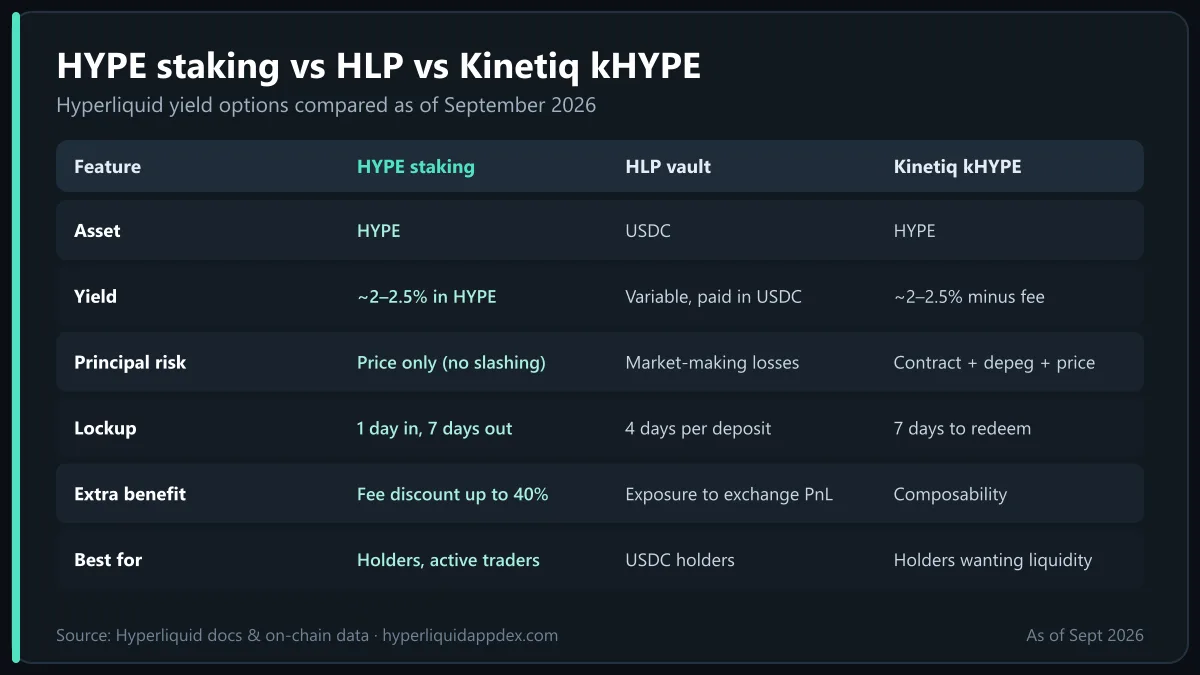
You can run staking and HLP side by side, but they are very different products; people searching "Hyperliquid yield" usually end up choosing between them:
| HYPE staking | HLP vault | Kinetiq kHYPE | HyperEVM lending | |
|---|---|---|---|---|
| Asset | HYPE | USDC | HYPE | USDC, HYPE, others |
| Yield (Sept 2026) | ~2–2.5% in HYPE | Variable, low single digits to low teens in USDC | ~2–2.5% minus fee, plus DeFi yield on top | 3–15% depending on market |
| Principal risk | Price only (no slashing) | Market-making losses, manipulation events | Contract + depeg + price | Contract + liquidation of borrowers |
| Lockup | 1 day in, 7 days out | 4 days per deposit | None to sell; 7 days to redeem | None |
| Extra benefit | Trading fee discount up to 40% | Exposure to exchange PnL | Composability | Composability |
| Best for | HYPE holders, active traders | USDC holders who want exchange exposure | HYPE holders who want liquidity | Active DeFi users |
The two are complementary rather than competing. A common setup among experienced users: stake enough HYPE to hit the Gold or Platinum discount tier, keep trading capital in the perp account, and park idle USDC in HLP. Details on HLP are in the Hyperliquid vaults guide.
Tax treatment of staking rewards
Tracking rewards as you go saves you a painful year-end: in most jurisdictions, including the US, UK, Australia and much of the EU, staking rewards are treated as income at the time they are received, valued at market price, and then as a capital asset from that point. Because Hyperliquid pays rewards continuously, tracking the cost basis of each accrual is tedious; most people use a crypto tax tool that reads the Hyperliquid API or exports from the app. kHYPE's value-accruing model can simplify this in some jurisdictions because you receive no separate reward token, but the rules vary. This is not tax advice; check with a professional in your country.
Quick reference
- Where: app.hyperliquid.xyz > Staking
- Minimum: any amount; 10 HYPE for the first fee tier
- APY: ~2–2.5% (September 2026)
- Lock in: 1 day
- Unstake: 7 days
- Slashing: none currently
- Liquid alternative: Kinetiq kHYPE
- Docs: Hyperliquid staking documentation and live HYPE data on CoinGecko
Bottom line
Staking HYPE on Hyperliquid gives you one of the lowest-risk returns available on the token: gas-free, no slashing in place, a 1-day lock going in, 7 days coming out, and about 2–2.5% APY. The headline yield is modest; the fee discount is what pays you if you trade, with 1,000 HYPE cutting your fees by 10% and 500,000 by 40%. Kinetiq's kHYPE is the right choice if you want the yield without the lock, at the price of smart-contract risk. Whichever route you pick, remember that HYPE's price will dominate your return, and use the Hyperliquid DEX referral link to stack the extra 4% discount on top of your staking tier.
Frequently Asked Questions
What is the Hyperliquid staking APY?
You earn roughly 2–2.5% per year from native HYPE staking as of September 2026, paid in HYPE. The rate is set by the protocol's emission schedule and falls as more HYPE is staked. The bigger win for active traders is the fee discount: staking 10 HYPE gives 5% off, 1,000 HYPE 10%, and 500,000 HYPE 40%.
How do I stake HYPE on Hyperliquid?
You can stake in a few clicks with no gas: buy HYPE on the Hyperliquid spot market, transfer it from your spot balance to your staking balance in the app, open the Staking tab, pick a validator, enter an amount and confirm. Staking and takes effect after a 1-day lockup. Rewards accrue automatically and compound when you restake them.
How long does it take to unstake HYPE?
Unstaking has a 7-day unbonding period. After you request an unstake, HYPE stays locked for seven days before it returns to your staking balance, and from there you can transfer it to spot. There is also a 1-day lockup right after you first stake before you can undelegate at all.
What is Kinetiq kHYPE?
Kinetiq lets you keep earning staking yield without locking your HYPE for 7 days. It is the leading liquid staking protocol on HyperEVM: you deposit HYPE, receive kHYPE, and Kinetiq stakes the underlying across a curated validator set. kHYPE stays liquid, so you can use it in HyperEVM DeFi. Redemption back to HYPE takes the standard 7-day unbonding period.
Is staking HYPE safe?
Staking carries no slashing risk as of September 2026; the main risks are validator downtime reducing rewards, HYPE price volatility, the 7-day exit delay, and, for kHYPE, smart-contract and depeg risk. Your HYPE never leaves your own address with native staking, which makes it one of the lower-risk yield options on Hyperliquid.
How does the staking fee discount work on Hyperliquid?
The discount is based on the amount of HYPE you have staked, measured over a 14-day window: Wood (10+) 5%, Silver (100+) 5%, Gold (1,000+) 10%, Platinum (10,000+) 15%, Emerald (100,000+) 25%, Diamond (500,000+) 40%. It stacks multiplicatively with volume-based VIP tiers and the 4% referral discount.
Ready to trade on the Hyperliquid app?
Open the official Hyperliquid DEX with our referral link and get a lifetime 4% discount on trading fees. No KYC, no gas fees, self-custody.
Open Hyperliquid App · Save 4%SIXPROSPERPaste the code in the referral field when you sign up (it must be applied before your first trade).
Disclaimer: This article is for educational purposes only and is not financial, investment or legal advice. Perpetual futures trading with leverage carries a high risk of loss. Read our full disclaimer.