
Hyperliquid USDT: Does Hyperliquid Accept USDT? USDC Collateral, USDT0, USDH and How to Convert (2026)
Hyperliquid USDT guide: perp margin is USDC only, USDT is not accepted as collateral. How USDT0, USDH, USDe and feUSD fit in, and how to convert USDT to USDC on Arbitrum cheaply (2026).

Hyperliquid USDT support is limited: you cannot use USDT as collateral for perpetuals, because every perp market on Hyperliquid is margined and settled in USDC that arrives through the Arbitrum bridge. USDT does exist on the platform, as the omnichain USDT0 token on spot markets and HyperEVM, alongside other stablecoins such as USDe, feUSD and the aligned quote assets that replaced USDH, but for trading you will need USDC. This guide explains exactly which stablecoins work where, why Hyperliquid is USDC-only for margin, how to convert USDT to USDC cheaply and quickly, and what the AQAv2 framework means for the future of quote assets on the exchange.
Key takeaways
- Perp margin is USDC only. Deposit USDC on Arbitrum through the native bridge; a native-USDC path via Circle's CCTP has also been rolled out for direct deposits from other chains (check the app's deposit menu for the current list).
- USDT is not accepted as collateral and sending USDT to the bridge contract will not credit your account.
- USDT0, USDe, feUSD and the AQAv2 aligned quote assets are spot or HyperEVM tokens, useful for DeFi and spot trading, not for perps.
- Cheapest conversion: withdraw USDC from your exchange directly on Arbitrum. Already holding USDT? Swap on an Arbitrum DEX or bridge-and-swap with deBridge, Jumper or Relay.
- Costs are small: an Arbitrum swap is cents, the Hyperliquid bridge deposit is free, withdrawals cost a flat $1 and take a few minutes.
- USDH was sunset in favour of AQAv2, which lets multiple aligned stablecoins share quote-asset status instead of one ticker.
Hyperliquid USDT: why collateral is USDC, not USDT
Hyperliquid's clearinghouse runs on a single collateral asset. Every perpetual market quotes in USD, margin is posted in USDC, funding is paid in USDC and PnL settles in USDC. A single-collateral design keeps the margin engine simple and deterministic, which matters for an exchange that liquidates positions on-chain in real time: there is no collateral haircut table, no cross-asset liquidation risk and no need to oracle-price the collateral itself.
USDC was chosen because it is the dominant stablecoin on Arbitrum, where Hyperliquid's bridge lives, and because Circle's issuance and redemption model made it the lower-risk option for an exchange holding billions in user collateral. The bridge contract on Arbitrum holds the deposited USDC (the TVL figures of roughly $5–7B quoted for Hyperliquid refer to this balance), and a validator quorum signs withdrawals back to Arbitrum.
USDT was never added as a second collateral type, and as of September 2026 there is no announced plan to do so. The practical consequences:
- You cannot deposit USDT to the bridge. The contract only recognises USDC transfers; USDT sent to it is not credited and recovery is not guaranteed.
- You cannot hold a USDT balance in the perps account.
- Spot markets quote mainly in USDC, so even spot trading starts with USDC.
That is the whole story for perps. Where it gets more interesting is the growing set of stablecoins that live on Hyperliquid's spot layer and on HyperEVM.
Stablecoins on Hyperliquid compared
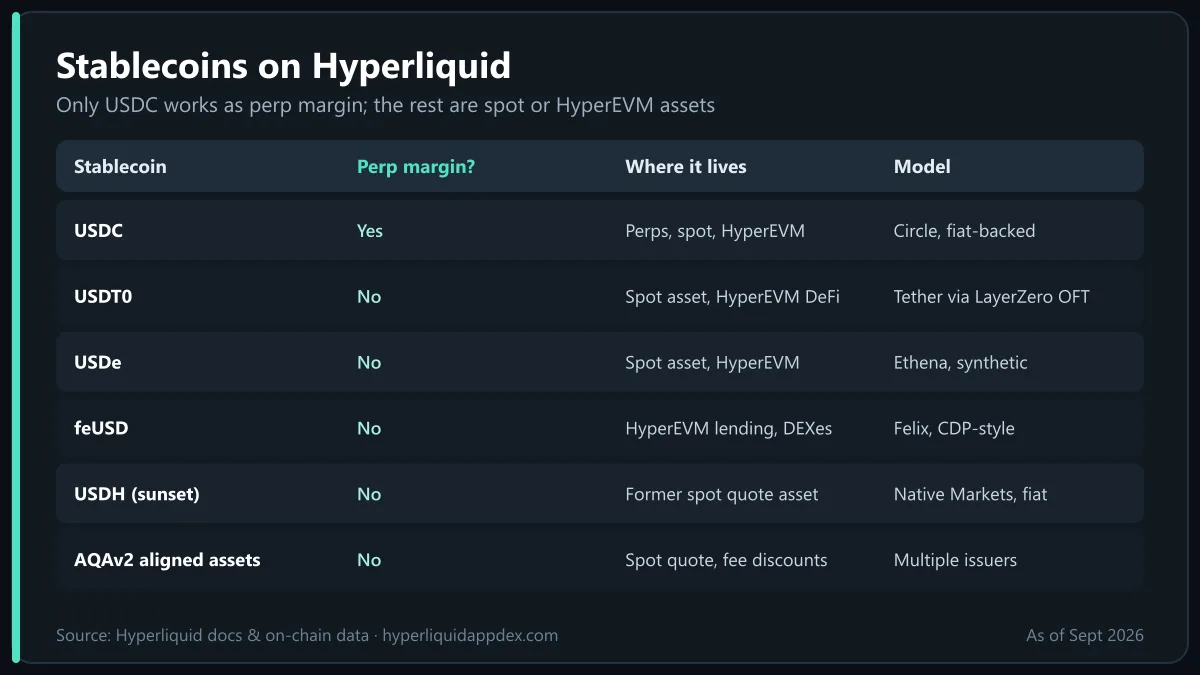
Hyperliquid has become a venue for several stablecoins, each with a different role. The table summarises how they behave on the platform as of September 2026.
| Stablecoin | Issuer / model | Where it lives on Hyperliquid | Perp margin? |
|---|---|---|---|
| USDC | Circle, fiat-backed | Perps collateral, spot quote, HyperEVM | Yes |
| USDT0 | Tether via LayerZero OFT, backed by USDT | Spot asset, HyperEVM DeFi | No |
| USDe | Ethena, synthetic (delta-hedged) | Spot asset, HyperEVM, Unit-bridged | No |
| feUSD | Felix, CDP-style, HYPE-collateralised | HyperEVM lending and DEXes | No |
| USDH (sunset) | Native Markets, fiat-backed | Spot quote asset, later wound down | No |
| AQAv2 aligned assets | Multiple issuers meeting alignment criteria | Spot quote assets with fee discounts | No |
USDC
The base asset. It arrives via the Arbitrum bridge or, for the newer native-USDC route, through Circle's cross-chain transfer protocol (CCTP) from supported chains; the app's deposit screen is the authority on which chains are currently enabled. On HyperEVM, USDC is also available as an ERC-20 for DeFi and can be moved between HyperCore and HyperEVM through the app. Everything in the bridge and deposit guide applies to USDC.
USDT0
USDT0 is Tether's omnichain USDT, deployed with LayerZero's omnichain fungible token standard and backed one-to-one by USDT locked on Ethereum. It launched on Hyperliquid in 2025 as a spot asset and quickly became the main form of USDT in HyperEVM DeFi: lending markets, DEX pools and yield vaults list it, and spot pairs such as USDT0/USDC let you convert on-exchange. It is the answer to "hyperliquid usdt" if you want to hold USDT in the ecosystem, but it is still not margin.
USDe
Ethena's USDe is a synthetic dollar backed by staked ETH and BTC with short perp hedges, and Hyperliquid is one of the venues where Ethena hedges. On Hyperliquid, USDe is a spot and HyperEVM asset with its own markets and yield products.
feUSD
feUSD is the stablecoin of Felix, a CDP protocol on HyperEVM where users borrow feUSD against HYPE and other collateral. It is the native-DeFi stablecoin of the ecosystem and is used mainly within HyperEVM lending and liquidity pools.
USDH and the AQAv2 aligned quote assets
USDH was Hyperliquid's attempt at a native stablecoin: in September 2025 validators voted to award the USDH ticker to Native Markets, which launched a fiat-backed stablecoin whose reserve yield was routed back to the Hyperliquid ecosystem. It became a spot quote asset with fee discounts and grew quickly.
The project was later wound down as Hyperliquid moved to AQAv2 (aligned quote assets, version 2). Instead of a single privileged ticker, AQAv2 defines criteria (reserve quality, yield sharing with the ecosystem, transparency) that any stablecoin can meet to be recognised as an aligned quote asset, earning reduced spot fees on pairs quoted in it and other integration benefits. The practical result is that spot markets can be quoted in more than one aligned stablecoin while perps remain USDC-margined. Details of which assets currently qualify are in the official docs and change over time, so verify before relying on a specific ticker.
How to convert USDT to USDC for Hyperliquid
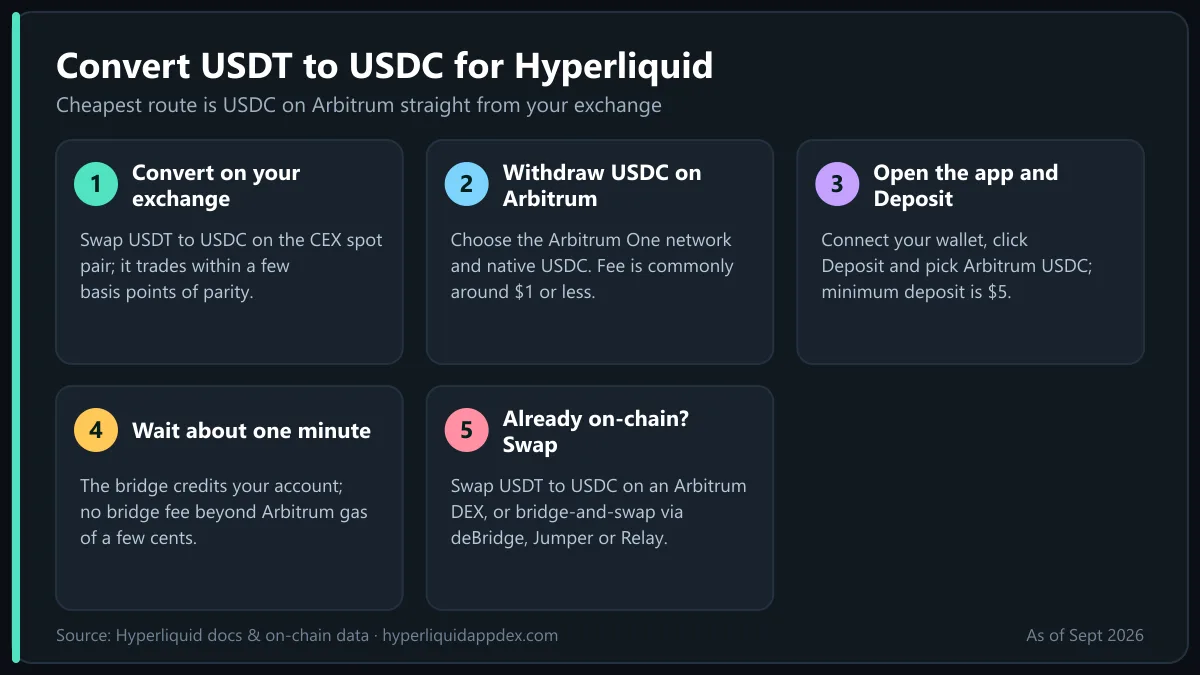
If you hold USDT and want to trade perps, you have three realistic routes. They differ mostly in where the swap happens.
Route 1: withdraw USDC directly from your exchange (cheapest)
If your USDT sits on a centralised exchange, do not withdraw it as USDT. Convert on the exchange (USDT/USDC spot pairs trade at or within a few basis points of parity on every major venue) and withdraw USDC on the Arbitrum One network. Then:
- Open the Hyperliquid app, connect your wallet and click Deposit.
- Choose Arbitrum USDC. The app shows the bridge contract address; the deposit is a plain USDC transfer to it from the connected wallet.
- Wait roughly one minute for the deposit to be credited. Minimum deposit is $5; there is no bridge fee beyond Arbitrum gas.
Total cost: the exchange withdrawal fee (commonly around $1 or less for Arbitrum USDC) plus a few cents of Arbitrum gas. Total time: a few minutes.
Route 2: swap USDT to USDC on Arbitrum
If your USDT is already on Arbitrum, swap it on Uniswap, Camelot or any aggregator. USDT/USDC pools on Arbitrum are deep enough that a $100,000 swap moves the price by a basis point or two, and gas is a few cents. Then deposit the USDC as above.
If your USDT is on Ethereum mainnet, swapping first and then bridging USDC to Arbitrum via the official Arbitrum bridge or a fast bridge (Across, Relay) works but costs mainnet gas; a bridge-and-swap aggregator (route 3) is usually cheaper.
Route 3: bridge-and-swap in one transaction
Aggregators such as deBridge, Jumper (LI.FI) and Relay accept USDT on Ethereum, BNB Chain, Solana, Tron, Base and others, swap to USDC, bridge to Arbitrum and in several cases deliver straight into your Hyperliquid account in a single flow. The Hyperliquid app's deposit menu lists the integrated options. Fees are typically 0.05–0.3% plus source-chain gas, and delivery takes one to ten minutes depending on the source chain.
This is the route for USDT on Tron or Solana, where there is no direct path to Arbitrum.
Route 4: convert on Hyperliquid itself
If you already have USDT0 on HyperEVM or in your Hyperliquid spot balance, sell it on the USDT0/USDC spot pair, then transfer the USDC from spot to perps with the one-click transfer in the app. The spot fee is 0.07% taker (less with an aligned quote asset discount or staking tier), and the transfer is instant.
👉 Open the Hyperliquid app and save 4% on fees
Fees and time for USDT to USDC conversion
The costs are small on every route, but they add up if you move size often. Here is what to expect as of September 2026.
| Step | Typical fee | Typical time |
|---|---|---|
| CEX USDT to USDC conversion | 0–0.1% (spot fee) | Instant |
| CEX withdrawal, USDC on Arbitrum | ~$0.5–2 flat | 2–10 minutes |
| Arbitrum DEX swap USDT to USDC | ~0.01–0.05% + cents gas | Seconds |
| Bridge aggregator (deBridge, Jumper, Relay) | 0.05–0.3% + source gas | 1–10 minutes |
| Hyperliquid bridge deposit | Free (Arbitrum gas only) | ~1 minute |
| Hyperliquid bridge withdrawal | $1 flat | ~3–5 minutes |
Two details catch people out. First, Hyperliquid withdrawals to Arbitrum are signed by validators and carry a flat $1 fee that is deducted from the amount; small withdrawals are therefore proportionally expensive. Second, the first withdrawal after a deposit can be delayed by the margin-maintenance rule introduced in 2025 (a portion of margin stays locked briefly on open positions), which is a security feature rather than a conversion issue. The fees guide covers all trading and transfer charges.
Hyperliquid and Arbitrum: why the bridge is where it is
Hyperliquid is its own L1 with its own consensus (HyperBFT), but its connection to the rest of crypto runs through Arbitrum. The native bridge is a contract on Arbitrum holding user USDC; deposits are USDC transfers to that contract and withdrawals are released by a two-thirds validator quorum. This was the simplest way to bootstrap an exchange in 2023 (Arbitrum had deep USDC liquidity and low fees) and it has stayed in place as volumes grew into the billions.
For a user, "hyperliquid arbitrum" means three practical things:
- Your deposit wallet needs a tiny amount of ETH on Arbitrum for gas (cents).
- Network selection matters: USDC on Arbitrum One, not Arbitrum Nova, not Ethereum, not Base.
- Native USDC and bridged USDC.e are different tokens on Arbitrum; the Hyperliquid bridge expects native USDC. Most exchanges withdraw native USDC by default, but if a swap gives you USDC.e, swap it to native USDC first.
The CCTP route changes this somewhat by letting Circle burn USDC on a source chain and mint it on the Hyperliquid side without an Arbitrum hop. It is available for a growing set of chains; the deposit screen shows what is live. Bitcoin, Ether and Solana can also be deposited natively through Unit, but those arrive as spot assets, not margin, so you still sell them for USDC to trade perps.
Hyperliquid stablecoin yield and DeFi uses
If you hold stablecoins on Hyperliquid for reasons other than margin, the ecosystem offers the usual DeFi menu on HyperEVM:
- Lending: HyperLend and similar money markets accept USDC, USDT0, USDe and feUSD as supply assets, with rates driven by borrowing demand from leveraged HYPE and looping strategies.
- Liquidity: DEX pools for USDC/USDT0 and USDC/USDe earn swap fees; the pairs are tight, so returns come from volume rather than spread.
- Spot quote markets: aligned quote assets under AQAv2 give fee discounts on pairs quoted in them, which is relevant if you trade HIP-1 spot tokens actively.
- Vaults: depositing USDC into the HLP vault or user vaults is a separate category of risk and return; see the vaults and HLP guide.
Risk note: synthetic and CDP stablecoins (USDe, feUSD) carry depeg and protocol risk that fiat-backed USDC and USDT0 do not, and none of them are suitable as a substitute for margin you may need in a liquidation.
Common mistakes with USDT and USDC on Hyperliquid
- Sending USDT to the bridge address. The contract ignores it. Convert first.
- Sending USDC on the wrong chain. Ethereum, Base, Polygon and Solana USDC do not arrive. Use Arbitrum or an integrated CCTP/aggregator route.
- Confusing USDC.e with USDC. The bridge wants native Arbitrum USDC.
- Depositing below the minimum. Deposits under $5 are not credited.
- Expecting USDT0 to count as margin. It is a spot asset; sell it for USDC and transfer to perps.
- Ignoring the $1 withdrawal fee on small test withdrawals.
If you are setting up for the first time, the how to trade on Hyperliquid guide walks through the full flow from wallet to first position on the Hyperliquid app DEX, and the what is Hyperliquid overview explains why the exchange is built this way.
Bottom line
Hyperliquid does not take USDT as collateral: perps are margined in USDC that enters through the Arbitrum bridge (or via native-USDC CCTP routes), and USDT appears only as USDT0 and other stablecoins on the spot and HyperEVM layers. Converting is cheap and quick on any route, with the simplest being to withdraw USDC on Arbitrum from your exchange and deposit it directly, and the most flexible being a bridge-and-swap aggregator such as deBridge or Jumper that handles USDT from any chain. USDH came and went in favour of the AQAv2 aligned quote asset framework, which broadens spot quoting without changing the USDC-only rule for margin. Hold whatever stablecoin suits your DeFi strategy, but keep your trading collateral in USDC.
Frequently Asked Questions
Does Hyperliquid support USDT?
Not as perp collateral. Margin for every perpetual market on Hyperliquid is USDC, deposited through the Arbitrum bridge. USDT exists on the platform only as spot assets (USDT0, the omnichain USDT on HyperEVM and HyperCore spot) and you cannot post it as margin. Convert USDT to USDC on Arbitrum before depositing.
What stablecoin does Hyperliquid use?
USDC is the settlement and collateral asset for perps and the main quote asset for spot. Other stablecoins live on the platform as spot or HyperEVM tokens: USDT0 (bridged USDT), USDe (Ethena), feUSD (Felix), and USDH (the native stablecoin that launched in 2025 and was later wound down in favour of the AQAv2 aligned quote asset framework).
How do I convert USDT to USDC for Hyperliquid?
The cheapest route is to withdraw USDC directly from your exchange on the Arbitrum network and skip USDT entirely. If you already hold USDT on-chain, swap it to USDC on an Arbitrum DEX such as Uniswap for a few cents, or use a bridge aggregator such as deBridge, Jumper or Relay that swaps and bridges in one transaction and can deliver straight into your Hyperliquid account.
Which network should I use to send USDC to Hyperliquid?
Arbitrum. Hyperliquid's native bridge accepts USDC on Arbitrum and credits your account within about a minute for deposits above $5. Sending USDC on Ethereum mainnet, Solana, Base or any other chain to the bridge address will not work; use a cross-chain aggregator that outputs Arbitrum USDC or lands directly on Hyperliquid.
Is USDT0 the same as USDT?
USDT0 is Tether's omnichain version of USDT built on LayerZero's OFT standard, backed 1:1 by USDT locked on Ethereum. On Hyperliquid it trades as a spot asset and is used across HyperEVM DeFi. It is redeemable for USDT but is not accepted as perp margin, so for trading you still need USDC.
What was USDH on Hyperliquid?
USDH was the Hyperliquid-native stablecoin ticker awarded to Native Markets by validator vote in September 2025, launched as a USD-backed stablecoin with reserve yield routed back to the ecosystem. It was later sunset as Hyperliquid introduced AQAv2, a framework that lets multiple aligned quote assets with the same profile share the role instead of a single ticker.

Trading on Hyperliquid since the 2024 points seasons. Follow on X · LinkedIn · YouTube
Ready to trade on the Hyperliquid app?
Open the official Hyperliquid DEX with our referral link and get a lifetime 4% discount on trading fees. No KYC, no gas fees, self-custody.
Open Hyperliquid App · Save 4%Disclaimer: This article is for educational purposes only and is not financial, investment or legal advice. Perpetual futures trading with leverage carries a high risk of loss. Read our full disclaimer.