
Hyperliquid Block Time, HyperBFT Consensus and the Hyperliquid L1 Explained: HyperCore, HyperEVM, Validators, Arbitrum Bridge and Launch Dates (2026)
Hyperliquid block time explained: HyperBFT consensus, sub-second finality, HyperCore vs HyperEVM, Arbitrum bridge, launch dates and decentralization (2026).

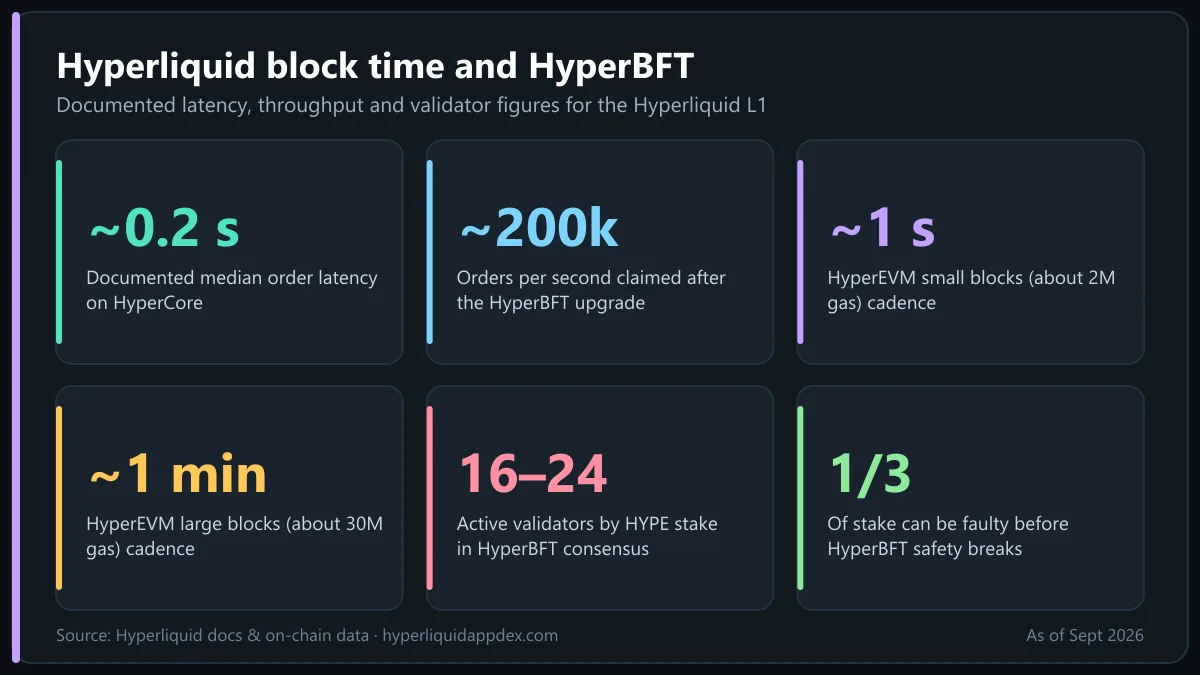
Hyperliquid block time is sub-second: the HyperBFT consensus finalizes blocks continuously rather than on a fixed interval, with a documented median latency of around 0.2 seconds from order submission to confirmation on HyperCore. On the HyperEVM side, the chain runs a dual-block schedule of small blocks roughly every second and large blocks roughly every minute. This page explains how the Hyperliquid L1 works end to end: the HyperBFT consensus, the HyperCore exchange engine, the HyperEVM smart-contract layer, the validator set, the Arbitrum bridge, the launch timeline and the honest answer to whether Hyperliquid is decentralized.
Key takeaways
- Hyperliquid block time: no fixed interval; HyperBFT produces blocks as fast as the network can agree, with ~0.2 s median latency documented for HyperCore and a 1 s / 1 min dual-block cadence on HyperEVM.
- Throughput: Hyperliquid Labs claims the chain can process around 200,000 orders per second after the 2025 HyperBFT upgrade; real-world load is far below that ceiling.
- Two execution layers, one chain: HyperCore runs the order books, vaults and staking; HyperEVM runs Solidity contracts and reads HyperCore state through precompiles.
- Hyperliquid launch date: closed alpha 2023, mainnet perps 2023, spot 2024, HYPE token Nov 2024, HyperEVM Feb 2025, HIP-3 Oct 2025, HIP-4 May 2026.
- Hyperliquid whitepaper: none exists; the official docs on GitBook are the reference.
- Is Hyperliquid decentralized? Proof of stake with a small validator set (roughly 16 to 24 active validators by stake) and partly closed-source node code. Improving, but not Ethereum-grade yet.
Hyperliquid block time: how fast is the Hyperliquid L1?
Most blockchains advertise a block time. Ethereum produces a block every 12 seconds, Solana targets roughly 400 milliseconds, Arbitrum posts batches every 250 milliseconds or so. Hyperliquid is different because it was designed as an exchange first and a general chain second, and an exchange cares about one number above all: how long between clicking "buy" and seeing the fill.
HyperBFT, the consensus algorithm behind the Hyperliquid network, does not wait for a timer. Validators propose and vote on blocks in a continuous pipeline, so a new block is finalized as soon as the previous round of votes is collected. Under normal load the official documentation describes a median end-to-end latency of about 0.2 seconds and a 99th percentile under one second for orders sent to HyperCore. In practice, when you place a market order on the Hyperliquid app DEX you usually see the fill before your finger leaves the mouse button.
Two caveats are worth stating plainly, because the numbers get repeated loosely online:
- These are documented figures, not independent benchmarks. Hyperliquid Labs publishes them; we have not seen a peer-reviewed audit of HyperBFT performance. Our own trading experience is consistent with sub-second confirmation, but treat precise decimals as marketing-adjacent.
- HyperEVM has its own cadence. Since the 2025 dual-block upgrade, HyperEVM produces small blocks (about 2 million gas) roughly every second and large blocks (about 30 million gas) roughly every minute, as documented. So "Hyperliquid block time" means ~0.2 s if you are asking about trading and ~1 s or ~1 min if you are asking about smart-contract transactions.
Throughput: the 200,000 orders-per-second claim
Before the HyperBFT upgrade, the original Tendermint-based chain was limited to roughly 20,000 operations per second. HyperBFT raised that ceiling by an order of magnitude; Hyperliquid Labs has cited around 200,000 orders per second as the current capacity, with further headroom from execution-layer optimizations. On record-volume days such as October 10, 2025, the chain processed more than $10 billion in liquidations without downtime, which is the closest thing to a public stress test. For comparison with Ethereum and Solana, see Hyperliquid vs Ethereum and Solana.
HyperBFT consensus: how the Hyperliquid network agrees on blocks
HyperBFT is a custom implementation of a HotStuff-derived Byzantine fault tolerant (BFT) protocol, the same family that underpins Aptos, Sui's earlier design and Diem's Jolteon. HotStuff's key property is linear communication: each validator only talks to the leader rather than to every other validator, which keeps message overhead low as the set grows, and it pipelines proposals so that voting on block N overlaps with proposing block N+1.
Hyperliquid's engineers rewrote the protocol in Rust and tuned it for one workload: an order book that must process many small transactions with deterministic ordering. The relevant design choices, as documented:
- Proof of stake with HYPE. Validators post HYPE as stake and are ranked by total stake, including delegations from users who stake HYPE. Rewards come from the staking emission, currently around 2 to 2.5% APY.
- Small, performance-selected validator set. Roughly the top 16 to 24 validators by stake are active in consensus at any time, with the exact number varying as stake moves. A smaller set means fewer round trips and faster finality, at a cost to decentralization (discussed below).
- One-third fault tolerance. Like all BFT protocols, HyperBFT stays safe as long as fewer than one third of active stake is faulty or malicious. Two thirds of stake must sign a block for it to finalize.
- Instant finality. Once a block is finalized it cannot be reorganized. There is no probabilistic "wait six confirmations" period as on Bitcoin.
- Deterministic state machine. Every validator runs the identical HyperCore engine, so every order, fill, funding payment and liquidation is reproduced bit-for-bit. That is what lets Hyperliquid run a fully on-chain central limit order book rather than an off-chain matcher with on-chain settlement.
If you want to go deeper, the official documentation at hyperliquid.gitbook.io has a HyperBFT section, and the founder's background in high-frequency trading explains much of the design philosophy; see our profile of Jeff Yan and Hyperliquid Labs.
Hyperliquid HyperCore vs HyperEVM: two layers, one state
The clearest way to understand the Hyperliquid blockchain is as a single chain with two execution environments that share consensus and state.
HyperCore
Hyperliquid HyperCore is the native, purpose-built state machine. It is not a virtual machine you can deploy to; it is a fixed set of components written by Hyperliquid Labs:
- Perpetual futures order books (BTC, ETH, SOL, HYPE and hundreds of other markets, plus HIP-3 builder markets for stocks, indices and commodities)
- Spot order books for HIP-1 tokens such as HYPE and PURR
- The clearinghouse: margin, funding every hour, liquidations and auto-deleveraging
- Vaults, including the HLP liquidity-provider vault
- Staking and delegation
- The USDC bridge accounting
Trading on HyperCore has zero gas; the cost is the maker/taker fee. Every action is signed by your wallet and ordered by consensus, which is why the Hyperliquid L1 can claim that the order book itself is on-chain.
HyperEVM
HyperEVM is a standard Ethereum Virtual Machine (chain ID 999, gas paid in HYPE) that launched on mainnet in February 2025. Anything you can build on Arbitrum or Base you can build here: lending (HyperLend, Felix), liquid staking (Kinetiq), DEXs (Kittenswap, Project X), stablecoins and NFT marketplaces. Our HyperEVM guide covers RPC setup and the ecosystem map.
Precompiles and CoreWriter: the bridge between the two
What makes HyperEVM more than "another EVM" is the set of precompiles at reserved addresses. A Solidity contract can call them to read HyperCore state directly: oracle prices, mark prices, a user's perp positions, spot balances, vault equity and staking data. A companion system contract, CoreWriter, lets contracts push actions back into HyperCore, such as placing an order, transferring between spot and perp, or delegating stake.
Because both layers are finalized by the same HyperBFT block, these reads are consistent and do not need an external oracle like Chainlink. A lending protocol on HyperEVM can liquidate against the exact mark price the exchange is using, in the same block. That shared state is the single biggest technical argument for building on Hyperliquid rather than on a general-purpose chain, and it is the main point of difference when people compare Hyperliquid vs Monad and MegaETH.
| Layer | What runs there | Gas | Who can deploy |
|---|---|---|---|
| HyperCore | Perp/spot order books, margin, funding, vaults, staking | None (fees only) | Hyperliquid Labs; HIP-3 deployers can add markets |
| HyperEVM | Solidity smart contracts, ERC-20s, NFTs, DeFi apps | HYPE | Anyone |
| Precompiles / CoreWriter | Read HyperCore state; send actions from EVM | HYPE (EVM side) | Called by any contract |
Hyperliquid and Arbitrum: why the bridge lives on another chain
A common search is "hyperliquid arbitrum", and the confusion is understandable. Hyperliquid is not built on Arbitrum and is not an Ethereum L2. It is its own L1 with its own validators. The link is the bridge: the canonical way to deposit USDC into Hyperliquid is to send USDC on Arbitrum to the Hyperliquid bridge contract, which the validator set watches and credits to your HyperCore account.
Why Arbitrum? When Hyperliquid launched in 2023 it needed a cheap, widely used chain with native USDC and deep liquidity for on-ramps. Arbitrum fit. The bridge is a smart contract on Arbitrum secured by signatures from Hyperliquid validators holding two thirds of stake; withdrawals require those signatures and carry a short dispute window, which is why a withdrawal takes a few minutes and costs about $1. As of September 2026 the bridge holds roughly $5 to 7 billion in USDC, making it one of the largest single bridge contracts in crypto and the main thing a security analysis of the chain has to reason about; see is Hyperliquid safe.
Alternatives have since appeared: Unit brings native BTC, ETH and SOL to the chain, and deBridge, Across, Relay and Jumper route from other networks. Step-by-step deposit instructions are in the bridge and wallet guide.
👉 Open the Hyperliquid app and save 4% on fees
Hyperliquid launch date and timeline
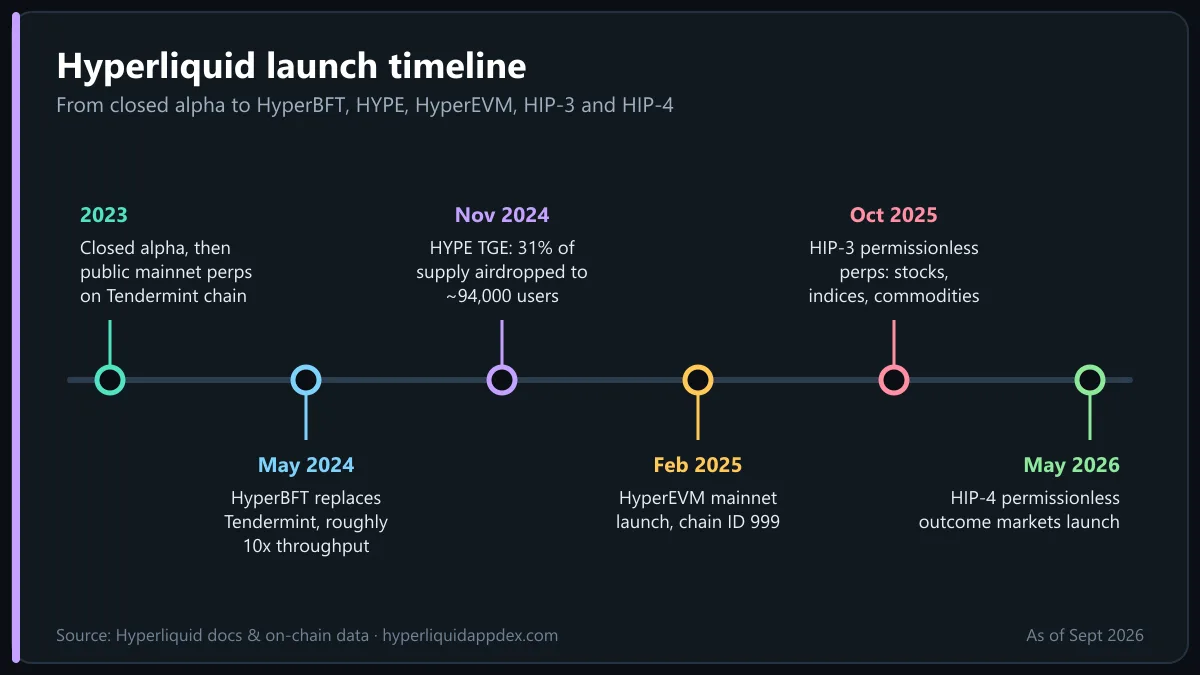
People search "hyperliquid launch date" expecting one date, but the chain shipped in stages. The timeline below uses the dates Hyperliquid Labs and the Hyper Foundation have stated publicly.
| Date | Milestone |
|---|---|
| Early 2023 | Closed alpha; Tendermint-based chain, invite-only perps trading |
| 2023 | Mainnet perpetuals open to the public; points program begins |
| 2024 | HIP-1 native spot tokens and HIP-2 Hyperliquidity; PURR is the first spot asset |
| May 2024 | HyperBFT replaces Tendermint, lifting throughput by roughly 10x |
| Nov 29, 2024 | HYPE token generation event; 31% of supply airdropped to ~94,000 users |
| Dec 2024 | Native HYPE staking and validator delegation go live |
| Feb 2025 | HyperEVM mainnet launch (chain ID 999) |
| Mar 2025 | JELLYJELLY incident; validators vote to delist and settle |
| Oct 13, 2025 | HIP-3 permissionless perp deployment; trade.xyz lists stocks, indices, commodities |
| May 2, 2026 | HIP-4 permissionless outcome markets launch |
| Aug 2026 | HIP-3 "Star" update; Bloomberg reports Kraken/Bitnomial talks for US access |
For the business and token side of this history, see what is the HYPE token and the Hyperliquid airdrop page.
Hyperliquid whitepaper and official documentation
There is no classic Hyperliquid whitepaper. Unlike Bitcoin, Ethereum or Solana, Hyperliquid Labs never released a formal paper describing the protocol. The team's stated view is that the product and the docs are the spec. If you find a PDF titled "Hyperliquid Whitepaper" on a third-party site, it is almost certainly an unofficial summary, an exchange research note or an AI-generated rewrite; verify anything it says against the primary source.
The primary sources are:
- Official docs: hyperliquid.gitbook.io/hyperliquid-docs. Sections cover HyperBFT, HyperCore (order books, margin, funding, liquidations, vaults), HyperEVM (precompiles, dual blocks, RPC), the bridge, the HIP-1/2/3/4 standards and the API.
- HIP proposals: published as docs pages rather than a governance forum; HIP-1 through HIP-4 are the ones that have shipped, with later HIPs extending the market standards.
- Hyper Foundation announcements: the foundation posts on X and in the docs when parameters change (for example the 500,000 HYPE HIP-3 deployer stake).
- GitHub:
hyperliquid-dexhosts the Python SDK, the node binary for non-validating nodes and some auxiliary tooling. Core consensus and matching-engine source is not fully public (see below). - API reference:
https://api.hyperliquid.xyz/infoand/exchange, documented in our Hyperliquid API guide.
Is Hyperliquid decentralized? An honest assessment
"Is hyperliquid decentralized" is one of the most searched questions about the chain, and it deserves a straight answer rather than a slogan. As of September 2026:
Where it is decentralized
- Consensus is proof of stake with public validators that anyone can delegate to. The validator list is visible in the app and on explorers such as Hypurrscan; see our Hyperliquid explorer guide.
- The order book, margin engine, liquidations and funding are all executed by consensus. There is no off-chain matching engine run by the company.
- The HYPE airdrop distributed 31% of supply to users with no VC allocation, so token-weighted governance is less concentrated than on most VC-backed chains.
- HIP-3 and HIP-4 let third parties deploy markets without permission from Hyperliquid Labs, provided they stake HYPE.
Where it is not (yet)
- Validator count. Only roughly 16 to 24 validators are active at any time, and a large share of stake sits with Hyper Foundation-affiliated validators. Ethereum has close to a million validators; Solana has over a thousand. A small set is a deliberate trade for latency, but it means a handful of entities could coordinate to halt the chain or, as in the JELLYJELLY case, vote to settle a market at a chosen price.
- Closed-source components. The node software for running a non-validating node is public, but the full consensus and matching-engine code is not open source as of this writing. Hyperliquid Labs has indicated it will open more of the code as the validator set matures.
- Bridge security. The Arbitrum bridge is secured by validator signatures rather than by Ethereum's consensus, so the bridge is only as decentralized as the validator set.
- Team influence. Hyperliquid Labs is roughly 11 people who still ship most core upgrades. That is efficient but means the roadmap is not set by token-holder vote.
Our view: Hyperliquid is more decentralized than any centralized exchange and than most "DEXs" that run off-chain matchers, but less decentralized than Ethereum, and roughly in the same band as other performance-first L1s. Weigh that against the benefits (speed, zero gas trading, on-chain transparency) and your own risk tolerance. Never keep more on any bridge-dependent chain than you can afford to lose.
Hyperliquid meaning: what does the name mean?
Hyperliquid is a compound of hyper (beyond, extreme) and liquid, in the financial sense of liquidity: how easily you can buy or sell without moving the price. The name is a mission statement. The founders' thesis was that on-chain exchanges had failed because they could not match the liquidity of Binance or a traditional exchange, and that a purpose-built L1 could close that gap. "Hyper liquidity" is therefore both the goal and the brand.
A few related terms that trip up newcomers:
- Hyperliquid vs HYPE: Hyperliquid is the chain and exchange; HYPE is its native token used for gas, staking and fee discounts.
- HyperCore / HyperEVM: the two execution layers described above.
- Hyperliquidity (HIP-2): a specific on-chain market-making mechanism for new HIP-1 tokens, not a synonym for the chain.
- HLP: the Hyperliquidity Provider vault that market-makes and backstops liquidations.
- Hypurr: the cat mascot and NFT collection.
- Hyper Foundation: the non-profit that coordinates grants and validator programs.
Also searched as: hyper liquidity, hyper liquid crypto, hyperliquid network, hyperliquid blockchain, hyperliquid chain.
Glossary of Hyperliquid L1 terms
| Term | Plain-English meaning |
|---|---|
| HyperBFT | Hyperliquid's HotStuff-derived proof-of-stake consensus; sub-second finality |
| HyperCore | Native engine for order books, margin, funding, vaults and staking |
| HyperEVM | Ethereum-compatible smart-contract layer, chain ID 999, HYPE gas |
| Precompile | Reserved contract address that lets HyperEVM read HyperCore state |
| CoreWriter | System contract that lets HyperEVM contracts send actions to HyperCore |
| Dual blocks | HyperEVM's ~1 s small blocks and ~1 min large blocks |
| Validator | Node that stakes HYPE and votes on blocks; ~16 to 24 active |
| Bridge | Arbitrum contract that custodies USDC deposits, secured by validator signatures |
| HIP-1 / HIP-2 | Native token standard / on-chain liquidity for new tokens |
| HIP-3 / HIP-4 | Permissionless perp markets / permissionless outcome markets |
| HLP | Protocol vault that provides liquidity and backstops liquidations |
| Finality | The point after which a block cannot be reversed; immediate on Hyperliquid |
Bottom line
Hyperliquid block time is best described as "as fast as consensus allows": HyperBFT delivers a documented median latency of about 0.2 seconds for trades, and HyperEVM adds a one-second / one-minute dual-block schedule. The chain's defining design choice is one state shared by an exchange engine (HyperCore) and a smart-contract layer (HyperEVM), bridged by precompiles so DeFi apps can read live prices and positions without oracles. The trade-offs are a small validator set and partly closed-source code, which is why the honest answer to "is Hyperliquid decentralized" is "more than a CEX, less than Ethereum, and improving." If the speed matters more to you than maximal decentralization, start with what is Hyperliquid and the how to trade guide.
Frequently Asked Questions
What is the Hyperliquid block time?
Hyperliquid does not have a fixed block interval like Ethereum's 12 seconds. HyperBFT finalizes blocks continuously, with a documented median end-to-end latency of roughly 0.2 seconds for orders on HyperCore. HyperEVM adds a dual-block schedule: small blocks about every second and large blocks about every minute, as documented by Hyperliquid.
What is HyperBFT?
HyperBFT is Hyperliquid's custom proof-of-stake consensus algorithm, derived from the HotStuff family of Byzantine fault tolerant protocols. Validators ordered by HYPE stake propose and vote on blocks in pipelined rounds, giving sub-second finality while tolerating up to one third of stake being faulty or malicious.
When did Hyperliquid launch?
Hyperliquid ran a closed alpha in early 2023, opened mainnet perpetuals trading later in 2023, added native spot trading via HIP-1 in 2024, released the HYPE token on November 29, 2024, launched HyperEVM in February 2025 and opened HIP-3 permissionless perp deployment in October 2025. See our what is Hyperliquid guide for the full story.
Is there a Hyperliquid whitepaper?
Not in the classic sense. Hyperliquid Labs never published a formal academic whitepaper. The canonical technical reference is the official documentation at hyperliquid.gitbook.io, which covers HyperBFT, HyperCore, HyperEVM, the bridge and the HIP standards. Third-party PDFs titled Hyperliquid whitepaper are usually summaries or unofficial reports.
Is Hyperliquid decentralized?
Partially. Validation is proof-of-stake with a small set of roughly 16 to 24 active validators selected by HYPE stake, and part of the node software is not yet open source. That is more centralized than Ethereum but comparable to several high-performance chains. Hyperliquid Labs has said it intends to expand the validator set and open the code over time.
What does the name Hyperliquid mean?
Hyperliquid combines hyper, meaning extreme or beyond, with liquid, as in liquidity: the ease of buying or selling an asset without moving its price. The name signals the chain's goal of offering deep, central-exchange-grade liquidity on-chain. People sometimes search for it as hyper liquidity or hyper liquid.

Trading on Hyperliquid since the 2024 points seasons. Follow on X · LinkedIn · YouTube
Ready to trade on the Hyperliquid app?
Open the official Hyperliquid DEX with our referral link and get a lifetime 4% discount on trading fees. No KYC, no gas fees, self-custody.
Open Hyperliquid App · Save 4%Disclaimer: This article is for educational purposes only and is not financial, investment or legal advice. Perpetual futures trading with leverage carries a high risk of loss. Read our full disclaimer.