
Hyperliquid Careers and Jobs: How Hyperliquid Labs, the Hyper Foundation and HyperEVM Protocols Hire (2026)
Hyperliquid careers explained: the ~11-person Hyperliquid Labs team, Hyper Foundation roles, how to apply, ecosystem jobs at HyperEVM protocols, hackathons, grants and contributor paths (2026).

Hyperliquid careers come in three flavours: a tiny, rarely hiring core team at Hyperliquid Labs (around 11 people), roles at the Hyper Foundation that supports the ecosystem, and a much larger pool of jobs at the independent protocols building on HyperEVM and HIP-3. There is no official careers page, no recruiter pipeline and no application form; the people who end up working on or around Hyperliquid almost always got there by building something first. This guide explains how each layer is structured, where real openings appear, which skills are in demand, and the contributor paths (HIP-3 deployer, builder codes, validator, hackathons, grants) that let you earn from the network without ever being hired.
Key takeaways
- Hyperliquid Labs is deliberately small: roughly 11 employees, self-funded, no VC, and it hires by referral and demonstrated work rather than job boards.
- The Hyper Foundation is a separate ecosystem entity that runs grants, delegation and community programmes; it occasionally takes on ecosystem, operations and developer-relations roles.
- Most "Hyperliquid jobs" are ecosystem jobs at HyperEVM protocols such as Kinetiq, Felix, HyperLend, Hyperdash, trade.xyz and Ventuals.
- Hackathons and grants are the front door. Winning or shipping at one is how most ecosystem hires and core-team contacts happen.
- You can be paid by the protocol without a job: HIP-3 deployers earn market fees, builder codes earn per-trade revenue, validators earn staking commission.
- Beware fake listings. Anyone offering a Hyperliquid job via DM, Telegram or a third-party "careers" domain that asks for a fee or wallet signature is a scam.
How Hyperliquid careers really work in 2026
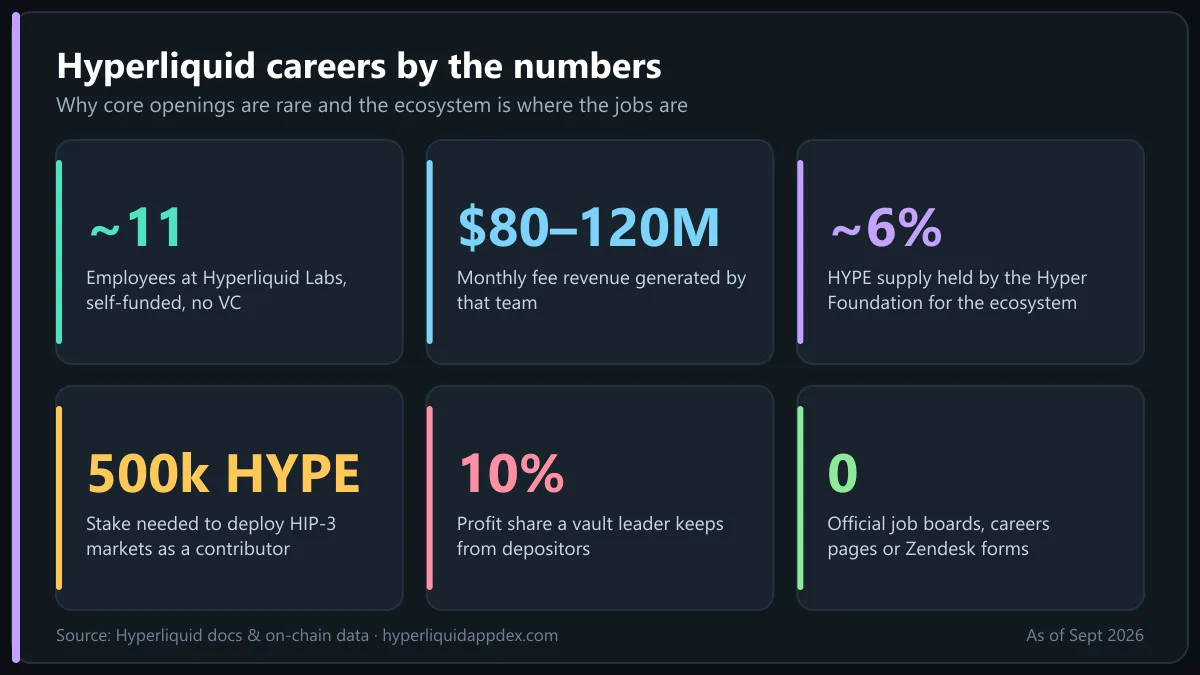
Hyperliquid is unusual among large crypto projects because it was built without venture funding and without the hiring sprees that funding brings. Founder Jeff Yan has said repeatedly that a small team of exceptional engineers outperforms a large one, and the numbers back him up: the exchange does on the order of $80–120M in monthly fee revenue with a team you could fit in a minivan, which is where the "highest revenue per employee in crypto" statistic comes from. The revenue and valuation guide runs through those figures.
That philosophy has three consequences for anyone looking for Hyperliquid careers:
- Core openings are rare and unadvertised. The Labs team has grown by ones and twos since 2023, almost always engineers or quants, and the hires tend to come from people the team already knew through their work.
- The ecosystem is where the headcount is. Hyperliquid's strategy is to be the infrastructure and let others build the products, so protocols on HyperEVM and deployers of HIP-3 markets employ many times more people than Labs does.
- Contribution is the application. Shipping a tool, winning a hackathon, running a validator, deploying a HIP-3 market or maintaining an SDK gets you noticed; a cold CV does not.
As of September 2026, treat anything that claims to be an official Hyperliquid job board with suspicion. The official channels are hyperliquid.xyz, the @HyperliquidX account on X, the official Discord and the Hyper Foundation's communications. Hyperliquid does not use Zendesk or similar helpdesks for support or hiring, and the team has warned about impersonators.
Hyperliquid Labs: the core team
Hyperliquid Labs is the company that designs and builds the L1, HyperCore (the order books, clearinghouse, vaults and staking) and HyperEVM. It was founded by Jeff Yan and his co-founder Iliensinc, both with backgrounds in high-frequency trading, and it is self-funded from the founders' prior market-making profits plus protocol revenue.
What is publicly known about the team:
- Size: around 11 people, a figure the project has stated and journalists have repeated through 2025 and 2026. The exact number is not published and may be slightly higher by now; treat it as "low double digits".
- Roles that have historically existed: core engineering (Rust, consensus, matching engine), quant and market-structure research, and a small amount of product and front-end work. There is no public evidence of a large marketing, sales or HR function; the team's public communication is done by founders and a handful of community-facing contributors.
- Hiring pattern: needs are occasionally mentioned on X or in Discord, typically for engineers with systems, HFT or distributed-systems backgrounds. There has never been a public job board, and reported hires have tended to come from the ecosystem or from the founders' professional networks.
- Location: the team is distributed, with reporting suggesting Singapore-linked operations; Labs does not publish office addresses.
If your goal is specifically to work at Labs, the honest advice is: be excellent at Rust or low-latency systems, contribute to the open parts of the stack (the Python SDK, node software, documentation, the API ecosystem), be visible in the developer Discord, and let the work speak. The team reads what builders ship.
The Hyper Foundation: ecosystem roles, grants and delegation
The Hyper Foundation is the ecosystem-support entity that sits beside Labs. It holds the foundation's allocation of roughly 6% of HYPE supply, and its remit covers grants, validator delegation programmes, community rewards, event sponsorship and developer education. It is structured as a non-profit-style foundation registered outside the United States, which is the standard model for L1 ecosystems; the precise jurisdiction and legal form are not something the foundation markets, so do not rely on third-party claims about them.
For job-seekers the foundation matters in two ways.
First, it is the entity most likely to hire for non-engineering roles: ecosystem growth, developer relations, grants operations, legal and compliance, events and community. These roles are still few, but they exist and are occasionally announced through the foundation's channels or filled from the pool of active community members.
Second, the foundation runs the grants programme, and a grant is often the closest thing to a Hyperliquid job that most builders will experience: funding to build a specific tool, integration, dashboard or protocol on HyperEVM or using the HyperCore API. Grant recipients typically become the people ecosystem protocols hire, and a few have gone on to work with the foundation itself.
The foundation also runs the delegation programme, which stakes foundation HYPE with community validators who meet performance and decentralisation criteria. Running a validator is covered in the contributor section below.
Hyperliquid jobs in the ecosystem: where the openings actually are
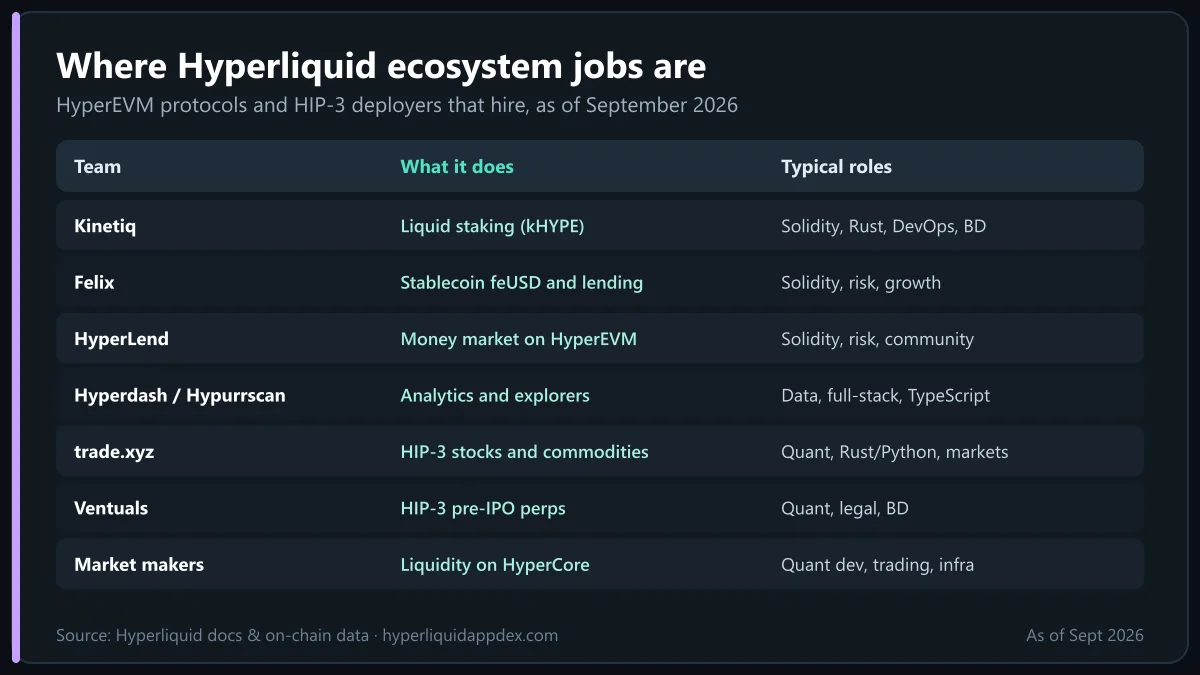
The real Hyperliquid job market is at the protocols that build on the network. HyperEVM launched in early 2025, HIP-3 opened permissionless perp deployment in October 2025, and by 2026 the ecosystem includes liquid staking, lending, stablecoins, DEXes, analytics firms and professional HIP-3 market deployers. These are independent companies with their own funding, their own teams and their own hiring. Some of the most active, as of September 2026:
| Team | What it does | Typical roles | Where to look |
|---|---|---|---|
| Kinetiq | Liquid staking (kHYPE) and validator infrastructure | Solidity, Rust, DevOps, BD | Official site and X |
| Felix | Stablecoin (feUSD) and lending on HyperEVM | Solidity, risk, growth | Official site and X |
| HyperLend | Money market on HyperEVM | Solidity, risk, community | Official site and Discord |
| Hyperdash / Hypurrscan | Analytics, explorers, whale tracking | Data, full-stack, TypeScript | Official sites and X |
| trade.xyz | HIP-3 deployer: stocks, indices, commodities | Quant, Rust/Python, market structure | Official site and X |
| Ventuals | HIP-3 pre-IPO perps | Quant, legal, BD | Official site and X |
| Market makers | Liquidity on HyperCore and HIP-3 markets | Quant dev, trading, infra | Firm sites and LinkedIn |
These names are illustrative; the ecosystem changes quickly and new teams appear with each hackathon cycle. What they have in common is that they publish openings on their own websites and X accounts, sometimes on general crypto job boards, and they recruit aggressively from the Hyperliquid developer community. The HyperEVM ecosystem guide and the HIP-3 builder markets guide describe what each layer does if you need context before applying.
Skills in demand
Based on what ecosystem teams consistently ask for:
- Rust for anything close to the chain: node operators, HIP-3 deployer infrastructure, high-performance trading systems and data pipelines consuming the WebSocket feed.
- Solidity and EVM tooling for HyperEVM protocols: lending, stablecoins, DEXes, vault wrappers and the CoreWriter/precompile integrations that let contracts read and act on HyperCore state.
- Python and TypeScript for trading bots, market-making, analytics and dashboards. Familiarity with the official SDK and the
/infoand/exchangeendpoints described in the API guide is a baseline expectation. - Quantitative finance and market structure for HIP-3 deployers and market makers: oracle design, margin parameters, funding, auction mechanics.
- Risk and compliance at stablecoin and lending protocols, and increasingly at HIP-3 deployers listing equities and pre-IPO markets.
- Growth, BD and community roles exist but are a small fraction of total openings.
Realistic expectations
Ecosystem jobs are start-up jobs. Many protocols are a handful of people, token-funded, and operating in a market that moves with HYPE and perp volumes. Compensation is commonly a mix of fiat or stablecoin salary and token allocations with vesting. Due diligence applies: check that the protocol has real TVL or volume on-chain (DefiLlama and the explorers make this trivial), that its contracts are audited, and that its treasury is not entirely in its own token. The is Hyperliquid safe guide covers the protocol-level risks that also apply to employers built on it.
👉 Open the Hyperliquid app and save 4% on fees
Hyperliquid hackathons and grants
If there is one reliable on-ramp into Hyperliquid careers, it is the hackathon-to-grant-to-hire pipeline.
Hackathons. The Hyper Foundation and ecosystem partners sponsor Hyperliquid-focused hackathons and build-a-thons, both online and at major crypto conferences. Tracks typically cover HyperEVM applications, HIP-3 market tooling, builder-code front-ends, analytics and trading bots, and HIP-4 prediction-market integrations. Prize pools vary by event; the more valuable outcome is that judges include core contributors and founders of the protocols listed above, and winning teams routinely receive follow-on grants and job offers.
Grants. The foundation's grants programme and several protocol-level programmes fund specific deliverables: SDKs in new languages, data infrastructure, educational content, integrations with wallets and bots, and public goods such as explorers. Grants are usually milestone-based and paid in HYPE or stablecoins. The application is informal by corporate standards (a proposal, a demo, a conversation), but competition is real and shipped code beats slide decks.
Open source. Contributions to the official SDKs, node software, documentation and community tooling are visible to everyone who matters. The SDK guide lists the repositories.
Contributor paths: earning from Hyperliquid without a job
Hyperliquid's design pays people for building and operating the network directly, which is why many of the most involved people in the ecosystem have no employer at all.
HIP-3 market deployer
HIP-3 lets anyone stake 500,000 HYPE and deploy their own perpetual markets with their own oracle, margin parameters and fee share. Deployers can take a share of trading fees on their markets, which for the largest deployers (trade.xyz's stock and commodity markets, for example) is a real business. This is capital-intensive, so most individuals contribute to deployer teams rather than running one, but the role of "HIP-3 deployer" is effectively a new job category created by the protocol. Details are in the HIP-3 guide.
Builder codes
Builder codes let any front-end, bot or app route orders to Hyperliquid and charge an additional fee on each trade, paid directly to the builder's address. Mobile apps such as Lootbase and Dexari, Telegram bots and TradingView integrations run on builder codes, and a single developer with a useful front-end can earn ongoing revenue. The trading bots and builder codes guide explains the mechanism and the fee caps.
Validator
Hyperliquid's HyperBFT consensus is run by a permissioned-by-stake validator set. Operators who can meet the hardware, uptime and stake requirements can run a validator, attract delegation (including from the Hyper Foundation's programme) and earn commission on staking rewards. It is an infrastructure business rather than a job, and the staking guide covers the economics.
Vault leader
Any trader can open a user vault, take deposits and keep 10% of profits. Successful vault leaders on the leaderboard effectively run small funds without any employer or licence; the flip side is that losses are public and depositors leave fast.
Content, data and tooling
Explorers, dashboards, Telegram alert bots, educational sites and research newsletters are how a large share of ecosystem contributors started. Several analytics teams in the table above began as one person with a Dune dashboard.
How to find and verify Hyperliquid job openings
Because there is no central board, the search is a routine rather than a page:
- Official channels first. hyperliquid.xyz, the official X account and Discord, and the Hyper Foundation's announcements. Core and foundation needs, when they are made public at all, appear here.
- Protocol sites and X accounts. Each ecosystem team posts its own openings. Follow the teams you would want to work for and check their sites monthly.
- Crypto job boards. General boards (the ones run by major VCs and the larger crypto-native boards) list HyperEVM protocol roles under the protocol's name, not under "Hyperliquid".
- Hackathon and grant announcements. These are time-boxed and recur; a calendar reminder outperforms a job alert.
- The developer Discord. Teams post "we're hiring" in builder channels before they post anywhere formal.
Verification matters. Legitimate roles never ask you to pay a fee, deposit funds, connect a wallet to "verify eligibility" or sign a transaction. The Hyperliquid team does not recruit via unsolicited DMs, and a domain that is not hyperliquid.xyz or a known protocol's own site is not official. When in doubt, ask in the public Discord.
Who works on Hyperliquid: team and culture notes
A few patterns stand out from public interviews, docs and the way the ecosystem operates, and they are worth knowing before you invest months in trying to join.
- Engineering-led. Decisions at Labs are made by people who write the code. The founders have HFT backgrounds and the product reflects it: latency, margin engine correctness and uptime are treated as the product.
- Public by default. Governance, incidents (the JELLYJELLY delisting, the HLP losses, the October 2025 crash) and roadmap items (HIP-3, HIP-4, portfolio margin) are discussed publicly, and contributors are expected to be comfortable with that.
- Long time horizons. Core contributor tokens are locked for a year and vest from 2027–2028 onward, and the Assistance Fund buyback model is explicitly designed around multi-year value accrual, which shapes how the team thinks about hiring.
- Credentials matter less than output. The team is small enough that every person must ship; ecosystem teams inherit that expectation.
If you are weighing whether to build on Hyperliquid at all, start by using the Hyperliquid app DEX as a trader and reading the what is Hyperliquid overview; the people who do best in this ecosystem are the ones who understand the product from the user side first.
Bottom line
Hyperliquid careers are real but they rarely look like a job posting. Hyperliquid Labs stays at around 11 people and hires engineers and quants by reputation, the Hyper Foundation adds a handful of ecosystem roles and funds builders through grants, and the bulk of openings are at the independent protocols on HyperEVM and the HIP-3 deployers, which hire through their own sites and the developer community. The fastest path in is to build something visible (a hackathon entry, a grant deliverable, a builder-code app, a validator or an open-source contribution), and the protocol itself will pay you for several of those before anyone offers you a salary. Ignore any listing that asks for money or a wallet signature; the official channels are the only ones that count.
Frequently Asked Questions
Is Hyperliquid hiring?
Rarely. Hyperliquid Labs is a self-funded team of roughly 11 people and has historically grown by one or two engineers or quants at a time, without public job boards. Most opportunities described as Hyperliquid jobs are actually at the Hyper Foundation or at the independent protocols building on HyperEVM, which hire far more often.
How do I apply for a job at Hyperliquid Labs?
There is no careers portal or Zendesk-style application form. Historically the team has announced hiring needs through the official X account and Discord and has recruited from people already contributing: builders shipping on HyperEVM, hackathon winners and open-source contributors to the SDKs and node software. Build something visible first, then reach out through official channels.
How many employees does Hyperliquid have?
Hyperliquid Labs has reported a team of around 11 people as of 2026, the smallest headcount of any top-tier exchange and the source of its frequently cited revenue-per-employee record. The Hyper Foundation and ecosystem protocols employ more people, but they are separate organisations.
What is the Hyper Foundation?
The Hyper Foundation is the ecosystem entity that supports Hyperliquid's growth: it runs grants, delegation programmes, community initiatives and hackathon sponsorships, and holds the roughly 6% of HYPE supply allocated to the foundation. It is structured as a non-profit-style foundation registered outside the United States and is separate from Hyperliquid Labs, the core development company.
Are there Hyperliquid hackathons?
Yes. Hyperliquid-focused hackathons and build-a-thons are run by the Hyper Foundation and ecosystem partners, often around HyperEVM, HIP-3 markets and builder-code apps, with prize pools and follow-on grants. They are the most reliable route into both ecosystem jobs and the attention of the core team.
What skills do Hyperliquid ecosystem jobs require?
Rust and systems programming for node, infra and core-adjacent work; Solidity and EVM tooling for HyperEVM protocols; Python or TypeScript for trading, market-making and data roles; and quantitative finance for HIP-3 deployers and market makers. Business and community roles exist at the foundation and at larger protocols but are fewer.

Trading on Hyperliquid since the 2024 points seasons. Follow on X · LinkedIn · YouTube
Ready to trade on the Hyperliquid app?
Open the official Hyperliquid DEX with our referral link and get a lifetime 4% discount on trading fees. No KYC, no gas fees, self-custody.
Open Hyperliquid App · Save 4%Disclaimer: This article is for educational purposes only and is not financial, investment or legal advice. Perpetual futures trading with leverage carries a high risk of loss. Read our full disclaimer.