
Hyperliquid Assistance Fund Explained: How HYPE Buybacks Work, Burn Mechanics, Buyback Dashboards and Unlocks (2026)
Hyperliquid Assistance Fund guide: how ~97–99% of perp fees buy HYPE on the open market, spot and auction fee burns, buyback dashboards, unlock schedule, buyback yield math and risks (2026).

The Hyperliquid Assistance Fund is the on-chain account that receives roughly 97–99% of Hyperliquid's perpetual trading fees and spends them buying HYPE on the open market, continuously, with no governance vote and no human discretion in between. It is the reason HYPE is routinely described as the crypto token with the most direct link between revenue and price: every dollar of perp fees becomes a bid for the token within the same day. This guide explains how the fund works, what is burned versus bought, how to read the buyback dashboards, how buybacks interact with team unlocks and the community reserve, how to compute buyback yield, how it compares with Binance's BNB burn and MicroStrategy-style treasuries, and where the risks are.
Key takeaways
- Perp fees → Assistance Fund → HYPE buybacks. Around 97–99% of perp fee revenue (as of September 2026) buys HYPE on the spot market; the fund holds, it does not sell.
- Spot fees and auction fees are burned, not bought: a smaller but permanent supply reduction.
- The fund holds tens of millions of HYPE, a significant share of circulating supply; check the live dashboard for today's figure.
- Everything is verifiable on-chain. The fund's address, its trades and its balance are public; Hypurrscan, Dune and DefiLlama track them.
- Unlocks are the counterweight. Core contributor vesting from late 2025 and the 38.9% community reserve add supply that buybacks partly absorb.
- Buyback yield (annual buybacks ÷ market cap) sits in the low single digits at current prices; it is a valuation anchor, not a guarantee.
How the Hyperliquid Assistance Fund works
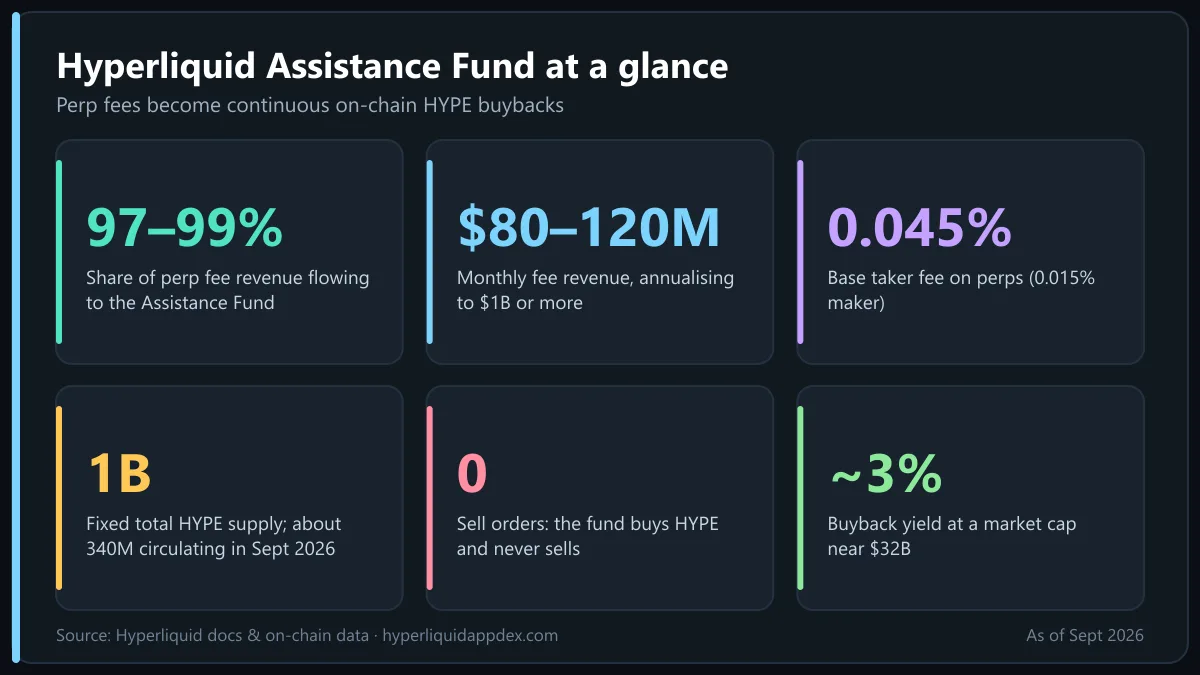
Hyperliquid charges a base fee of 0.045% taker and 0.015% maker on perps (lower at VIP tiers), as described in the fees guide. Unlike a centralised exchange, where fees go to a company, Hyperliquid's protocol splits them by rule:
- A share of fees is paid out to referrers (4% discount to the referred trader, a rebate to the referrer) and to the HLP vault when it acts as liquidator or liquidity provider.
- HIP-3 markets send a portion to the market deployer who staked HYPE to list them.
- The remainder, which has been roughly 97–99% of perp fees since the protocol redirected HLP's former fee share in 2025, flows to the Assistance Fund.
The Assistance Fund (often abbreviated AF) is a system address on HyperCore. Its only behaviour is to take the USDC it receives and buy HYPE on the HYPE/USDC spot order book. Purchases are executed continuously in small clips rather than in announced lumps, so the fund is effectively a permanent bid in the book proportional to the exchange's volume. The HYPE it buys stays in the fund. There is no mechanism for it to sell, and no governance process that routinely spends it; its original purpose, stated at launch, was to be a reserve that could compensate users in extreme events, which is where the name comes from.
The practical outcome is that Hyperliquid's roughly $80–120M per month in fee revenue (annualising to $1B or more, per the revenue and valuation guide) is almost entirely converted into HYPE demand. That is an unusually high payout ratio; most "revenue-sharing" tokens distribute a small fraction, and most equities pay out well under half of earnings.
The fund address and how to verify it
The Assistance Fund address is public and labelled on every major Hyperliquid explorer. Open the address on Hypurrscan or HyperScan and you will see a HYPE spot balance, a USDC balance that is continuously spent, and a fill history consisting entirely of HYPE buys. Because every fill on Hyperliquid settles on-chain, there is no need to trust a reported figure: cumulative buybacks are the sum of the fund's fills, and the current holding is its balance. The explorer guide walks through reading address pages.
Hyperliquid burn versus buyback: what actually leaves supply
"Hyperliquid burn" and "Hyperliquid buybacks" are often used interchangeably and they are not the same thing. The table shows where each fee stream ends up.
| Fee stream | Destination | Effect on HYPE supply | Reversible? |
|---|---|---|---|
| Perp trading fees (~97–99%) | Assistance Fund buys HYPE | Removed from circulation, held | In theory (fund holds, never sells) |
| Perp fees (remainder) | Referral rebates, HLP, HIP-3 deployers | Neutral (paid in USDC) | n/a |
| Spot trading fees in HYPE | Burned | Permanently destroyed | No |
| HIP-1 ticker auction fees | Burned | Permanently destroyed | No |
| HyperEVM gas (paid in HYPE) | Base fee burned | Permanently destroyed | No |
| HIP-3 deployer stake (500k HYPE) | Locked while markets run | Temporarily out of circulation | Yes, on exit |
The burn component is small relative to buybacks because spot volume is a fraction of perp volume and auction fees are episodic, but it is permanent. The buyback component is large but technically reversible: the HYPE sits in a fund that could, by validator governance in an emergency, be used. In practice the market treats fund holdings as removed from float, and both buyback dashboards and most analysts report "supply removed" as burns plus fund holdings.
Total supply is fixed at 1,000,000,000 HYPE. With roughly 340M circulating as of September 2026 (the figure used in the HYPE token guide), a fund holding in the tens of millions is a meaningful double-digit percentage of float, which is why the fund's balance is one of the first numbers HYPE holders check.
Hyperliquid buyback dashboards: where to watch
The fund is transparent by design, and several dashboards present the same on-chain data in different ways.
- Hypurrscan Assistance Fund page. The standard reference. Shows the fund's current HYPE balance, USD value, daily and cumulative buys, and the fund's share of circulating supply, with charts going back to launch.
- Dune dashboards. Community analysts maintain Dune queries on daily fee revenue, daily HYPE purchased, average purchase price and fund holdings over time. Useful for exporting data and for comparing buyback pace with price.
- DefiLlama. Lists Hyperliquid's fees, revenue and "holders' revenue" (the portion returned to token holders via buybacks), which makes it easy to compare Hyperliquid's payout with other protocols on a like-for-like basis.
- HyperDash and the app leaderboard. Both label the fund's address, so you can see it ranked by account value and open its positions page like any whale; see the leaderboard guide.
- The app's spot order book. Watch HYPE/USDC and you will see the fund's small, regular taker buys on the tape.
When you compare dashboards, expect small differences in cumulative totals depending on whether they count burns, whether they value holdings at current or purchase price, and when they started indexing.
👉 Open the Hyperliquid app and save 4% on fees
Hyperliquid unlocks and how buybacks interact with them
Buybacks reduce float; unlocks increase it. Understanding both is essential to reading the fund's effect on price.
The supply schedule
HYPE's allocation at the November 29, 2024 genesis was roughly: 31% airdrop (fully liquid from day one), 38.888% future emissions and community rewards, 23.8% core contributors, 6% Hyper Foundation, 0.3% grants and 0.012% HIP-2. The HYPE token guide and airdrop guide cover the breakdown.
The two unlock streams that matter:
- Core contributor vesting. The 23.8% team allocation was locked for one year after launch and then began vesting on a monthly schedule from late 2025, with the bulk scheduled across 2027–2028. Monthly amounts are modest relative to daily volume but material relative to the fund's monthly purchases, and the team has said contributors will not sell to the Assistance Fund or front-run its buys; that is a commitment, not a smart-contract rule.
- Community reserve. The 38.9% (38.888%) future emissions allocation is released at the project's discretion for incentives, staking rewards and future programmes. There is no fixed schedule, which is both a strength (no cliff) and a source of uncertainty.
Net supply math
The useful way to think about it is a monthly balance:
Net float change ≈ (team unlock + community emissions sold) − (Assistance Fund buys + burns)
In months when fee revenue is high (roughly $100M buys at, say, $80 per HYPE is about 1.25M HYPE), buybacks can absorb a sizeable part of a monthly vest. In months when revenue is low or price is high, the vest outweighs buybacks. Neither side is fixed: revenue tracks volume, and volume tracks market volatility, so the fund buys most aggressively in exactly the volatile periods when prices are moving.
Note that unlocked tokens are not the same as sold tokens. Vested contributor HYPE may be staked or held; dashboards tracking the contributor addresses give a better picture than the raw schedule.
Hyperliquid buyback yield: the valuation math
Investors who value HYPE on fundamentals use buyback yield, the token equivalent of a dividend or buyback yield on a stock.
Buyback yield = annualised Assistance Fund purchases ÷ market cap
Worked example with September 2026 figures used elsewhere on this site: revenue of around $1B+ per year flowing almost entirely to the fund, circulating supply of roughly 340M HYPE and a price that set a new all-time high of about $96 on September 21, 2026, giving a market cap near $32B. That produces a buyback yield in the region of 3% per year. Using fully diluted value (about $96B at that price) instead of circulating market cap cuts the yield to around 1%.
How to read it:
- A 3% buyback yield funded by real fees is high for a large-cap crypto asset and comparable to the dividend-plus-buyback yield of a mature equity.
- The yield is inversely related to price. When HYPE hit its ATH in September 2026 the yield compressed; in the 2025 drawdowns it was several times higher. Buyback yield is a mean-reverting valuation signal, not a return promise.
- Revenue is the input that can grow. If volume doubles while price is flat, yield doubles; the price prediction guide uses exactly this revenue-multiple framework for its scenarios.
Risk note: a buyback yield does not accrue to you as cash; it is value returned via reduced float and continuous demand, and it can be more than offset by unlocks, falling volume or sentiment.
Comparison: Assistance Fund vs BNB burn vs MSTR-style treasuries
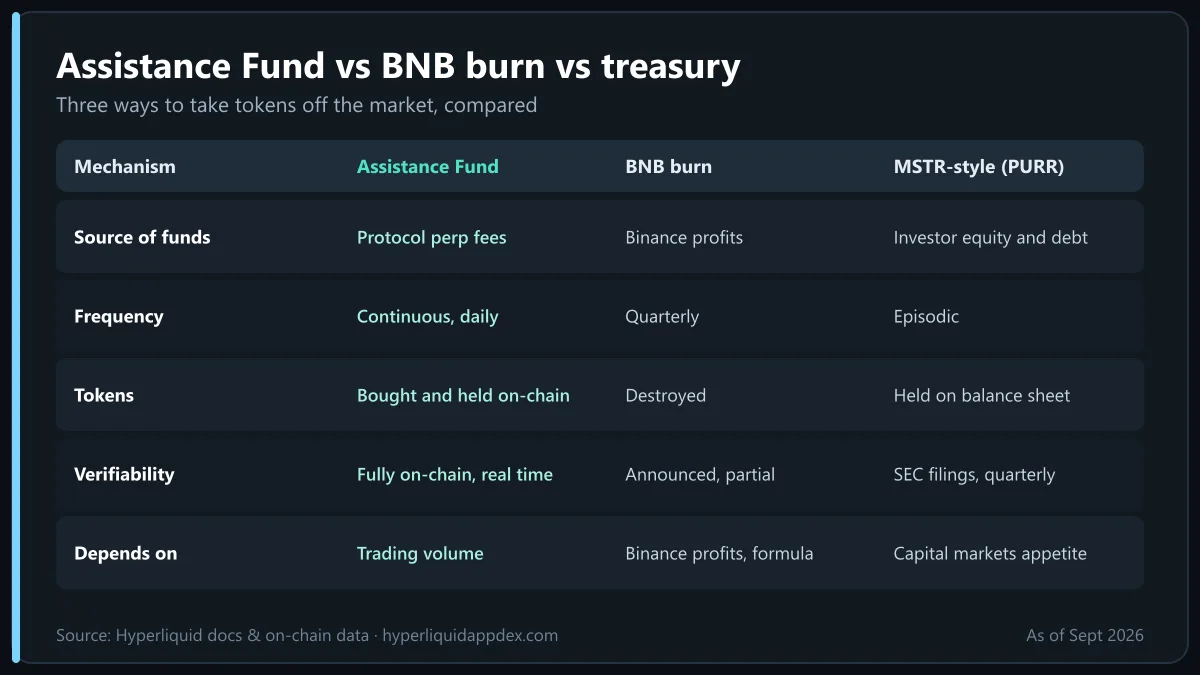
Hyperliquid's model is sometimes compared with two other famous token or equity sinks. The differences matter.
| Mechanism | Hyperliquid Assistance Fund | Binance BNB burn | MSTR-style treasury (PURR) |
|---|---|---|---|
| Source of funds | Protocol perp fees, on-chain | Binance profits (auto-burn formula) | Equity and debt raised from investors |
| Frequency | Continuous, every day | Quarterly | Episodic, market-dependent |
| What happens to tokens | Bought and held in a public fund | Destroyed | Held on a corporate balance sheet |
| Verifiability | Fully on-chain, real time | Announced, partially verifiable | SEC filings, quarterly |
| Dependence | Trading volume | Binance profitability and BNB price formula | Capital markets appetite |
Binance's BNB burn is quarterly, formula-driven and destroys tokens permanently, but it depends on a private company's reported figures. Hyperliquid Strategies (Nasdaq: PURR), the HYPE treasury company covered in the ETF and stock guide, buys HYPE with money raised from investors the way MicroStrategy buys bitcoin; that is external capital, not protocol revenue, and it stops when markets stop funding it. The Assistance Fund sits in between: it is continuous and verifiable like a burn, but it accumulates rather than destroys, and it is funded by the exchange's own cash flow rather than by selling shares.
Risks and criticisms of the Assistance Fund model
The design is elegant, but it is not free of risk, and the critiques are worth taking seriously.
- Volume dependence. Fees fall when markets go quiet. A prolonged low-volatility period cuts buybacks exactly when price support is most wanted. Competition from Lighter, Aster and others for perp share directly reduces the fund's inflow.
- Reflexivity. Buybacks support price, price supports sentiment, sentiment supports volume. The loop runs in reverse too.
- Governance discretion. The fund's behaviour is set by protocol parameters that validators can change. The payout share has already been changed once (upward, in 2025); it could be changed again. The reserve could in principle be deployed in a crisis, as its name implies.
- Regulatory optics. A token whose value is explicitly tied to revenue through buybacks looks more security-like to some regulators than a pure utility token. Hyperliquid's US-market talks (see the US availability guide) may shape how this is handled.
- Unlock overhang. Contributor vesting runs for years and the community reserve is discretionary. Buybacks offset supply; they do not eliminate the overhang.
- Price insensitivity. The fund buys at any price, which means it buys most at the top when volumes are high. That is good for holders only if revenue is sustained.
- Concentration. A fund holding a double-digit share of float is itself a concentration risk if its governance ever changed.
None of these are arguments that the model is broken; they are the reasons the buyback yield is not a risk-free rate.
How to track the fund yourself
If you want to monitor the Assistance Fund without relying on any dashboard:
- Find the fund address on Hypurrscan (it is labelled) and open its page on the app explorer.
- Note the HYPE spot balance. Divide by circulating supply from CoinGecko or CoinMarketCap to get the fund's share of float.
- Sum recent fills to get daily buys in HYPE and USDC; compare with DefiLlama's daily fee figure to confirm the ~97–99% share.
- Divide annualised USDC spent by current market cap for buyback yield.
- Cross-check against the contributor vesting schedule for the month to estimate net float change.
Doing this once makes every later headline about "record buybacks" or "massive unlock" easy to put in proportion. Then trade HYPE, or anything else, on the Hyperliquid app DEX knowing where the fees you pay end up.
Bottom line
The Hyperliquid Assistance Fund turns roughly 97–99% of perp fee revenue into continuous, on-chain HYPE purchases that are held rather than sold, while spot and auction fees are burned outright, giving HYPE one of the most direct revenue-to-token links in crypto. The fund holds tens of millions of HYPE, a significant share of circulating supply as of September 2026, and its every purchase is visible on Hypurrscan, Dune and DefiLlama. The counterweights are team vesting from late 2025, the discretionary 38.9% community reserve and the model's dependence on volume, so treat the low-single-digit buyback yield as a valuation anchor rather than a promise, and watch the fund's balance against the unlock schedule month by month.
Frequently Asked Questions
What is the Hyperliquid Assistance Fund?
The Assistance Fund is a protocol-controlled account on Hyperliquid that receives the large majority of perpetual trading fee revenue (around 97–99% as of 2026) and uses it to buy HYPE on the open spot market, continuously and automatically. The HYPE it buys is held in the fund rather than sold, which makes it the main mechanism linking exchange revenue to the token.
Does Hyperliquid burn HYPE?
Partly. Spot trading fees paid in HYPE and the proceeds of HIP-1 ticker auctions are burned, permanently reducing supply. Perp fees are not burned; they go to the Assistance Fund, which buys HYPE and holds it. The combined effect of burns and buybacks removes HYPE from circulation, but only the burned portion is destroyed.
How much HYPE does the Assistance Fund hold?
Tens of millions of HYPE as of September 2026, representing a significant share of circulating supply; the exact figure changes daily and is visible on-chain. Check a live dashboard such as Hypurrscan's Assistance Fund page, Dune or DefiLlama for the current balance, cumulative buybacks and the fund's share of supply.
Where can I see Hyperliquid buybacks in real time?
The fund address is public, so any explorer shows its purchases. The most used buyback dashboards are the Hypurrscan Assistance Fund page, several community Dune dashboards tracking daily and cumulative buys, and DefiLlama's revenue and holders-revenue pages, which express buybacks as a share of fees. The leaderboard and HyperDash also label the fund's address.
How do HYPE unlocks affect buybacks?
Core contributor tokens (about 23.8% of supply) were locked for a year after the November 2024 launch and began vesting on a monthly schedule from late 2025 onward, while the 38.9% community reserve is released at the team's discretion. Buybacks absorb part of this new supply; whether they fully offset it depends on fee revenue versus the unlock pace in any given month.
What is Hyperliquid's buyback yield?
Buyback yield is annualised buyback spending divided by market cap. At roughly $1B or more in annual fee revenue flowing to the fund and a market cap in the low tens of billions as of September 2026, the yield is in the low single digits per year, comparable to a dividend yield on a mature equity. It rises when volume grows or price falls and shrinks when price outruns revenue.

Trading on Hyperliquid since the 2024 points seasons. Follow on X · LinkedIn · YouTube
Ready to trade on the Hyperliquid app?
Open the official Hyperliquid DEX with our referral link and get a lifetime 4% discount on trading fees. No KYC, no gas fees, self-custody.
Open Hyperliquid App · Save 4%Disclaimer: This article is for educational purposes only and is not financial, investment or legal advice. Perpetual futures trading with leverage carries a high risk of loss. Read our full disclaimer.