
Hyperliquid Strategies: 10 Trading Strategies for Perps, Funding Arbitrage, Vaults and HIP-3 Markets (2026)
Hyperliquid strategies explained: trend following, funding-rate arbitrage, HIP-3 basis trades, vaults, HLP, grid bots and hedging, with risk rules (2026).

Hyperliquid strategies fall into four families: directional trading with disciplined margin, market-neutral yield such as funding-rate arbitrage and HLP, passive copy-trading through vaults, and event trades on HIP-3 stock and pre-IPO markets. One disambiguation first: if you searched "Hyperliquid Strategies" looking for the Nasdaq company, that is Hyperliquid Strategies Inc. (ticker PURR), the HYPE treasury firm, and it is covered in our ETF and stock guide. This article is about trading strategies you can actually run on the Hyperliquid app DEX: ten approaches, the position-sizing and risk rules that make them survivable, a comparison table of risk versus time commitment, and an honest view of what profit and PnL look like.
Key takeaways
- Fees and funding decide most strategies. 0.015% maker / 0.045% taker base fees and hourly funding are the inputs; read them before any plan.
- Market-neutral strategies (funding arbitrage, basis trades, HLP) target single-digit to low-double-digit annualised yields with no directional bet.
- Directional strategies (trend, breakout, mean reversion) live or die on position sizing; use isolated margin and risk 0.5%–2% per trade.
- Vaults let you copy a strategy with one deposit; always check drawdown history, not just returns.
- HIP-3 markets open up basis, carry and pre-IPO event trades that do not exist on other DEXs.
- Hyperliquid has no toggle-style hedge mode; hedge with spot, correlated markets or sub-accounts.
Hyperliquid strategies start with the fee and funding maths
Every strategy below is a bet that your edge is larger than your costs, so get the costs straight first.
- Trading fees: 0.045% taker / 0.015% maker on perps at the base tier as of September 2026, falling with 14-day volume, minus staking discounts (5%–40%) and the 4% referral discount. A round trip at taker rates costs about 0.09% of notional; at maker rates 0.03%. Full tables in the Hyperliquid fees guide.
- Funding: paid hourly between longs and shorts, capped at 4% per hour, driven by the perp premium over the oracle. Positive funding means longs pay shorts. It is a cost for one side and an income for the other, which is the entire basis of strategy 2. See Hyperliquid funding rates.
- Liquidation: maintenance margin is half of initial margin at max leverage; large positions are backstopped by HLP. The leverage and liquidation guide has the formulas.
- Gas: none on HyperCore, which makes high-frequency and grid approaches viable in a way they are not on most chains.
A strategy that needs 20 round trips a day at taker rates burns 1.8% of notional in fees before any PnL. The same strategy with maker orders burns 0.6%. That single choice outweighs most "alpha".
Strategy 1: Trend following with isolated margin
The simplest durable Hyperliquid strategy: buy strength, sell weakness, and let position sizing protect you.
How it works: pick two or three liquid majors (BTC, ETH, SOL, HYPE). Define trend with a rule you can follow mechanically, for example price above the 50-period moving average on the 4-hour chart with higher highs. Enter with a limit order in the trend direction, place a stop below the last swing low, and trail it as the trend extends.
Hyperliquid specifics: use isolated margin so a stopped-out trade cannot touch the rest of your account; keep leverage at 2x–5x even though 40x is available; prefer maker entries. Hyperliquid's TradingView charts make the rule-following easy (see TradingView charts on Hyperliquid).
Risk: whipsaw in ranging markets. Expect 40%–50% win rates with wins larger than losses; the strategy makes its money in a few big moves a year.
Strategy 2: Funding-rate arbitrage (long spot, short perp)
The classic delta-neutral trade and the strategy most people mean by "funding arbitrage".
How it works: when the perp funding rate is persistently positive (longs paying shorts), buy the asset on Hyperliquid spot and short an equal notional in the perp. Price moves cancel out; you collect funding every hour. Unwind when funding turns negative or compresses below your fee hurdle.
Worked example: $10,000 spot BTC and a $10,000 BTC perp short. If funding averages 0.01% per hour (a moderately bullish market), you earn about $1 per hour, roughly $720 a month, or around 7% a month on the $20,000 deployed before fees, which is an unusually good stretch; in calm markets 0.001%–0.003% per hour is more typical, giving 0.7%–2% a month. Fees to open and close both legs at maker rates: about 0.03% × 2 legs × 2 sides, or $12.
Hyperliquid specifics: spot and perps sit in one account, so rebalancing is instant and free of gas. Spot fees (0.07%/0.04%) are higher than perp fees; count them. Assets available on Hyperliquid spot (HYPE, PURR, BTC/ETH/SOL via Unit) are the candidates; for others, hold spot on another venue and accept the exchange-risk split.
Risk: funding flips negative and you pay instead of earn; the perp short gets liquidated in a violent squeeze if under-collateralised (keep the short at 1x–2x with ample margin); spot leg price falls are offset but your USDC margin requirement grows.
Strategy 3: Basis and carry across HIP-3 stock perps
HIP-3 brought stock, index and commodity perps to Hyperliquid, and with them the carry trades of traditional finance.
How it works: a stock perp such as xyz:NVDA or xyz:TSLA trades 24/7 while the underlying trades only during market hours. The perp often drifts to a premium or discount versus the last oracle print overnight and at weekends, and funding reflects that gap. A carry trader shorts the perp when it is rich relative to the oracle (or longs when cheap) and holds for funding plus convergence, hedged with the underlying stock, an ETF or a correlated perp.
Hyperliquid specifics: deployer fees add up to 50% on top of base fees on HIP-3 markets; leverage is lower (typically 3x–20x). Oracles update only when the underlying market is open, so weekend positioning is where the premium builds. Our HIP-3 builder markets guide and stocks on Hyperliquid list the available names.
Risk: gap risk at Monday open; oracle and deployer risk; hedging with real stock requires a brokerage and time-zone discipline.
👉 Open the Hyperliquid app and save 4% on fees
Strategy 4: Mean reversion on majors
How it works: on BTC and ETH, sharp intraday moves beyond a volatility band (for example two standard deviations from a 20-period mean on the 15-minute chart) tend to retrace partly. Fade the extreme with a limit order, target the mean, and use a tight stop beyond the extreme.
Hyperliquid specifics: maker-only entries are essential because the edge per trade is small (0.3%–1%); taker fees would eat it. Deep BTC and ETH books on Hyperliquid give good fills. Avoid this around scheduled macro events and on thin alts, where "extremes" become trends.
Risk: a mean-reversion trade is a short-volatility bet; one trend day can erase a week of small wins. Risk 0.5% of equity per trade at most.
Strategy 5: Breakout trading on new listings
How it works: new perp listings on Hyperliquid, and new HIP-1 spot tokens after their ticker auctions, see heavy volume and volatile first sessions. The strategy buys a break above the first hour's high (or shorts a break below the low) with a stop inside the range, aiming for the follow-through that often comes as traders discover the market.
Hyperliquid specifics: new listings usually launch with low leverage caps (3x–5x), which limits both upside and damage. Watch the funding rate: extreme positive funding at launch often precedes a fade.
Risk: the highest-variance strategy here. Thin early books, wide spreads and reflexive moves; treat it as a small-size, high-attention game.
Strategy 6: Copy-trading through vaults
How it works: Hyperliquid vaults let any trader run strategies with depositors' capital and take a performance share (10% of profits to the leader by default). Depositing into a vault copies the leader's positions proportionally, with no setup beyond the deposit. Withdrawals are subject to a lockup.
How to pick: on the Vaults page and explorers, look at the vault's age, maximum drawdown, consistency of returns, and whether the leader has meaningful own capital in it. A 300% return with a 70% drawdown is a lottery ticket, not a strategy. The vaults and HLP guide covers due diligence in detail.
Risk: full exposure to the leader's decisions, including leverage you cannot control; lockups mean you cannot exit in a crash.
Strategy 7: HLP, the passive market-neutral vault
How it works: the Hyperliquidity Provider vault is the protocol's own market-making and liquidation vault. Deposit USDC and you share proportionally in its PnL: the spread it earns providing liquidity, plus liquidation income, minus losses when it is on the wrong side of a move. It has historically produced moderate positive returns, with occasional drawdowns such as the JELLYJELLY episode in March 2025 and a roughly $4M hit from a whale's ETH position the same month.
Hyperliquid specifics: no fees to deposit, a lockup on withdrawals, and no leader fee. It is the lowest-effort "Hyperliquid strategy" and the one that most resembles an index of the exchange's activity.
Risk: HLP is the liquidator of last resort; in a cascade it absorbs positions, and a badly handled large liquidation can dent it. Returns are not guaranteed and have been lumpy.
Strategy 8: Grid and TWAP bots
How it works: a grid bot places layered limit buys below and sells above the current price, profiting from oscillation in a range; a TWAP splits a large order into slices over time to reduce market impact. Hyperliquid supports native TWAP and scale orders in the app, and the API makes custom grids straightforward.
Hyperliquid specifics: zero gas and maker rebates at high volume tiers make grids far cheaper than on AMM-based DEXs. Use an API wallet (agent key) with no withdrawal permissions. 3commas, Freqtrade and a wave of Telegram bots support the exchange via builder codes; see trading bots and builder codes.
Risk: grids lose when price leaves the range; a one-sided break leaves you holding inventory at a loss. Set grid boundaries with a stop, and never run an unattended grid on a market with a pending binary event.
Strategy 9: Hedging a spot bag
How it works: you hold HYPE, BTC or another asset you do not want to sell (tax, conviction, staking lockup), but you expect a drawdown or want to lock in a price. Short the equivalent notional in the perp. Your net exposure is zero while the hedge is on; you pay or receive funding and give up upside for the duration. Close the short when you want exposure back.
Hyperliquid specifics: staked HYPE is locked for seven days on unstaking, which makes a perp short the practical way to hedge it (see Hyperliquid staking). Spot held on Hyperliquid counts toward your account value, so the hedge needs less fresh USDC than on a separate venue. Because Hyperliquid has no toggle-style "hedge mode", long spot plus short perp is the hedge-mode equivalent; sub-accounts let you hold opposing perp positions if you must.
Risk: a hedge that is too large becomes a net short; funding on a crowded short can be expensive; forgetting to close it turns a hedge into a missed rally.
Strategy 10: Pre-IPO and event trades on HIP-3
How it works: HIP-3 pre-IPO perps (SpaceX, Anthropic, OpenAI and others, from trade.xyz and Ventuals) and HIP-4 outcome markets let you trade specific events: a reported funding round, an IPO filing, an earnings print on a stock perp, a macro release on gold or oil. The trade is a defined thesis with a defined catalyst and a defined exit, sized small because the oracle can gap.
Hyperliquid specifics: low leverage caps (3x–5x on pre-IPO), deployer fees, and oracles that update in steps. Read our SpaceX pre-IPO perp guide before trading any private-company market.
Risk: valuation opacity and oracle risk on top of the usual; the "event" can be priced in long before it happens.
Position sizing and risk rules that apply to every strategy
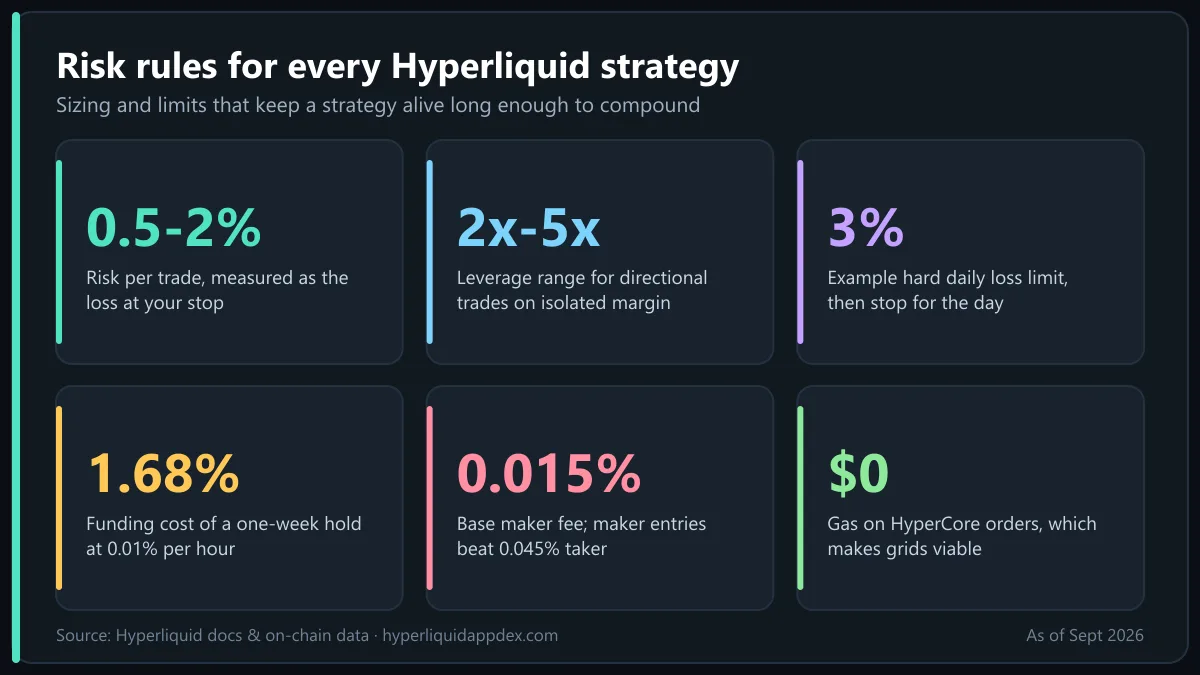
The difference between a Hyperliquid strategy that compounds and one that blows up is almost always sizing, not signal. Rules we would not trade without:
- Risk per trade: 0.5%–2% of account equity, defined as the loss at your stop, not the margin posted. On a $10,000 account, a 1% risk with a 5% stop distance means a $2,000 position, regardless of leverage.
- Isolated margin for directional trades, cross margin only for hedged books you monitor.
- Leverage is a capital-efficiency tool, not a position-size tool. Decide the notional first, then choose leverage that keeps liquidation far from any plausible wick.
- Cap correlated exposure. Long BTC, ETH and SOL at the same time is one trade, not three.
- Count funding in the plan. A position held for a week at 0.01% hourly funding costs 1.68% of notional.
- Hard daily loss limit (for example 3% of equity), after which you stop for the day. Hyperliquid's 24/7 markets make "one more trade" available at 3 a.m.; the limit is your defence.
- Keep withdrawal rights off API keys and run bots on testnet first (testnet guide).
- Review your PnL by strategy monthly, using your fills and funding history from the app or an explorer, so you know which approach actually makes money.
Risk note: leveraged trading can lose more than you expect, quickly; none of the above is investment advice.
Strategies compared: risk, time and realistic returns
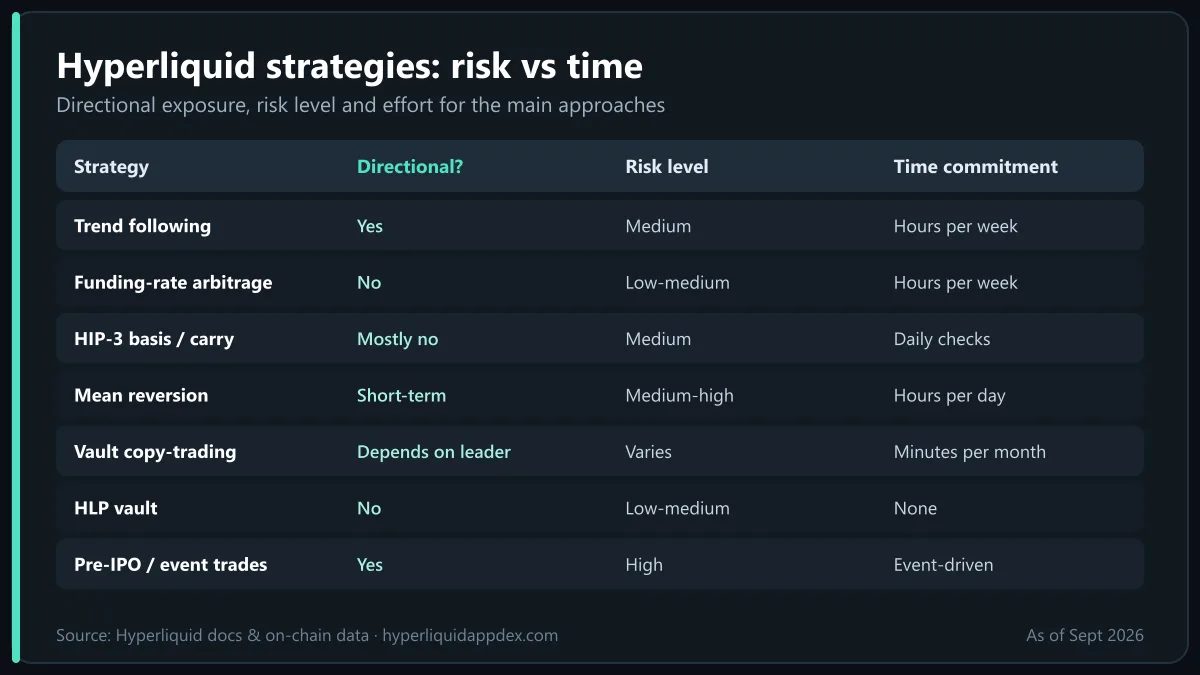
| Strategy | Directional? | Risk level | Time commitment | Realistic outcome range |
|---|---|---|---|---|
| Trend following | Yes | Medium | Hours per week | −20% to +50%/yr, lumpy |
| Funding-rate arbitrage | No | Low–medium | Hours per week | 3%–15%/yr, varies with sentiment |
| HIP-3 basis / carry | Mostly no | Medium | Daily checks | 5%–20%/yr, event risk |
| Mean reversion | Short-term | Medium–high | Hours per day | Small steady wins, rare big losses |
| New-listing breakouts | Yes | High | Event-driven | Wide; many small losses, few big wins |
| Vault copy-trading | Depends on leader | Varies | Minutes per month | Tracks leader; lockup applies |
| HLP vault | No | Low–medium | None | Mid single digits to low teens/yr historically |
| Grid / TWAP bots | No (in range) | Medium | Setup + monitoring | 1%–5%/month in ranges, losses on breaks |
| Hedging a spot bag | Neutralising | Low | Occasional | Protects value; costs funding |
| Pre-IPO / event trades | Yes | High | Event-driven | Binary-ish; size small |
Return ranges are illustrative, based on how these strategies have behaved historically, and are not predictions.
What Hyperliquid profit and PnL really look like
The leaderboard is seductive: a handful of accounts show eight-figure PnL. What it does not show is the long tail of accounts that lost, the whales whose profits came from a single leveraged bet that could easily have gone the other way (James Wynn's public swings in 2025 are the canonical example), or the hedges those accounts hold elsewhere.
Realistic framing for an individual trader:
- Market-neutral strategies on a few tens of thousands of dollars might produce a few hundred to a couple of thousand dollars a month in good conditions, and roughly zero in bad ones.
- Directional strategies with proper sizing swing between modest losses and strong gains, and the annual result is dominated by a few trades.
- Costs are predictable; edge is not. Reducing fees via maker orders, volume tiers, staking discounts and a referral code is the only "free" PnL on the platform.
If a strategy promises steady 10% a month, it is either taking a hidden tail risk or it is not real.
Bottom line
The best Hyperliquid strategies are the ones whose costs you have measured and whose risk you have capped: funding-rate arbitrage and HLP for market-neutral yield, trend following and mean reversion with isolated margin for directional trading, vaults for hands-off copying, and HIP-3 basis and pre-IPO trades for opportunities unique to this exchange. Hyperliquid's zero gas, maker rebates and unified spot-plus-perps account make several of these cheaper to run than anywhere else, but the leverage on offer punishes bad sizing just as fast. Start small, keep a per-trade risk limit, and learn the mechanics in how to trade on Hyperliquid and the official docs before scaling up.
Frequently Asked Questions
What is the best Hyperliquid strategy for beginners?
Start with one of the lower-effort approaches: depositing into the HLP vault for passive, market-neutral exposure, or simple trend following on BTC and ETH with isolated margin and 2x to 3x leverage. Both teach you how fees, funding and liquidation work without the complexity of multi-leg arbitrage. Paper-trade on testnet first.
How does funding-rate arbitrage work on Hyperliquid?
You buy an asset on Hyperliquid spot (or hold it elsewhere) and short the same size in the perp. Your price exposure nets to zero, and you collect the hourly funding payments when the rate is positive. Returns depend entirely on how long funding stays positive, minus fees and the cost of keeping both legs balanced.
Is Hyperliquid Strategies the same as Hyperliquid trading strategies?
No. Hyperliquid Strategies Inc. is a Nasdaq-listed treasury company (ticker PURR) that holds HYPE tokens. This article covers trading strategies you can run on the Hyperliquid exchange. The company is covered in our ETF and stock guide.
Does Hyperliquid have hedge mode?
Hyperliquid uses a one-position-per-market model rather than a Binance-style hedge mode toggle: buying while short reduces or flips the position. To hold opposing exposures you can use sub-accounts, hedge a spot balance with a perp short, or hedge one market with a correlated one. Portfolio margin and unified-account features have been rolling out.
How much profit can you make on Hyperliquid?
There is no typical figure. Funding arbitrage historically yields single-digit to low-double-digit annualised returns in calm markets; HLP has returned in a similar range; directional trading ranges from large gains to total loss. The leaderboard shows a few traders making millions and far more losing. Plan around risk per trade, not a target profit.
Can I automate strategies on Hyperliquid?
Yes. The API and official Python SDK support grid, TWAP, market-making and signal-driven bots, and platforms such as 3commas and Freqtrade integrate with Hyperliquid. Use an API wallet (agent key) with no withdrawal rights, test on testnet, and respect rate limits. Builder codes let third-party bots charge a small fee per order.

Trading on Hyperliquid since the 2024 points seasons. Follow on X · LinkedIn · YouTube
Ready to trade on the Hyperliquid app?
Open the official Hyperliquid DEX with our referral link and get a lifetime 4% discount on trading fees. No KYC, no gas fees, self-custody.
Open Hyperliquid App · Save 4%Disclaimer: This article is for educational purposes only and is not financial, investment or legal advice. Perpetual futures trading with leverage carries a high risk of loss. Read our full disclaimer.