
Hyperliquid Portfolio Margin, Unified Account, Cross vs Isolated Margin, Hedge Mode and Sub-Accounts Explained With Worked Examples (2026)
Hyperliquid portfolio margin explained: choose the margin mode that caps your losses, isolated vs cross, unified account, hedge mode and sub-accounts (2026).
You decide how much any single trade can cost you by picking the right margin mode, and Hyperliquid portfolio margin is, as of October 2026, a feature that has been announced and is rolling out rather than something every trader can switch on: the live margin system still offers two modes, isolated and cross, with cross margin backing each position with your entire perp account value. Our guide explains both modes with worked numbers, what portfolio margin would change when it fully arrives, how far the "unified account" (spot and perp balances working together) has come, why Hyperliquid has no hedge mode and how sub-accounts fill the gap, and what your options are for options, given that the exchange does not list them.
Key takeaways
- Isolated margin: a fixed collateral amount per position; only that amount can be liquidated, so a bad trade costs a known sum. Cross margin: all cross positions share the whole perp balance; more efficient, more dangerous.
- Hyperliquid portfolio margin (risk-based netting across offsetting positions) is on the roadmap and partially rolling out as of 2026; check the docs before assuming it applies to you.
- Unified account: perps and spot share one wallet with instant, free transfers; selected spot assets as perp collateral has been introduced per the docs, but full spot-perp unified margin is still in progress.
- No hedge mode: positions are net per market, but sub-accounts, a second wallet or correlated markets still let you hold long and short at once.
- No native options. Structured products and options protocols live on HyperEVM.
- Maintenance margin is half of initial margin at max leverage; liquidations above a size threshold go to the HLP vault.
Hyperliquid portfolio margin, cross and isolated: the three modes at a glance
Every perp venue has to decide how much collateral stands behind a trade and what happens when it runs out; on Hyperliquid you make that call yourself, per market. The live system is a conventional two-mode choice, plus a third mode (portfolio margin) that is arriving in stages.
| Mode | Collateral backing a position | Liquidation risk | Capital efficiency | Status on Hyperliquid |
|---|---|---|---|---|
| Isolated | Only the margin you assigned to that position | Limited to that margin | Low | Live; default on many alts |
| Cross | Entire perp account balance + unrealized PnL of all cross positions | Whole account | Medium | Live; default on majors |
| Portfolio margin | Account risk measured on the net portfolio; offsetting positions reduce requirements | Whole account | High | Announced / rolling out (2026); verify in docs |
Below, each mode in detail. For the formula behind liquidation prices, start with the Hyperliquid liquidations guide; the examples here build on it.
Isolated margin on Hyperliquid
Isolated margin gives you a hard cap on what one idea can cost: you allocate a specific amount of USDC to one position. The position's leverage is notional divided by that margin, and the position is liquidated when losses eat the margin down to the maintenance requirement. Your other positions and your free balance are untouched.
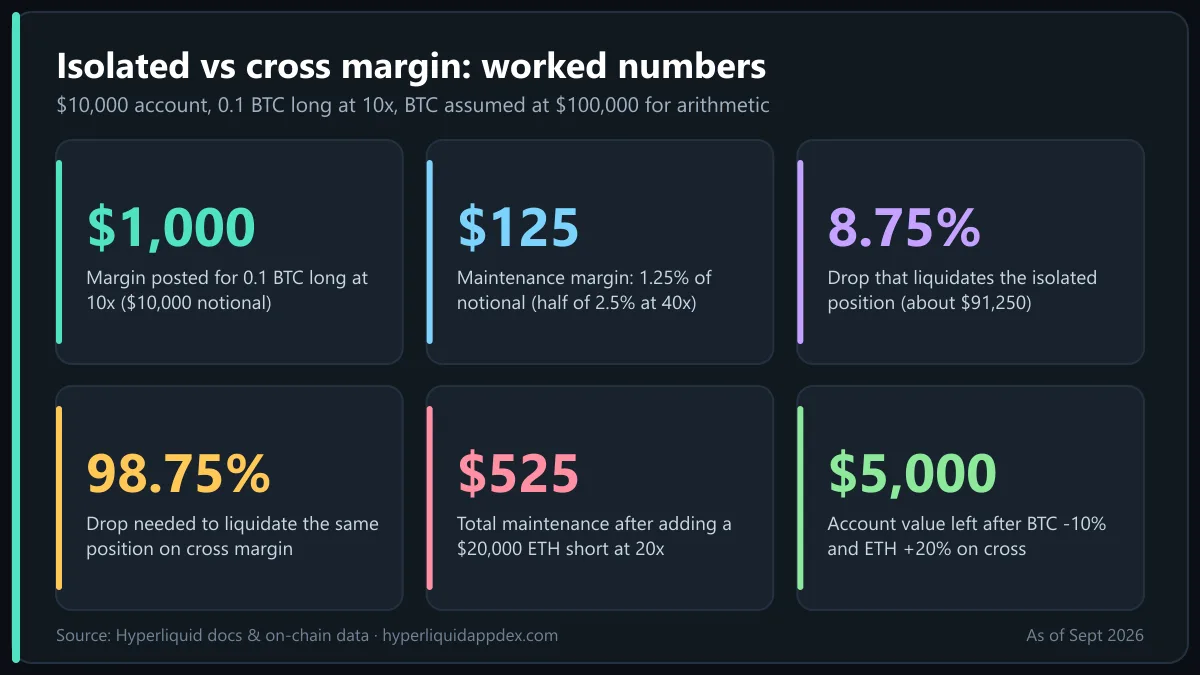
Worked example (isolated). Assume BTC at $100,000 for arithmetic (not a live price). You open a 0.1 BTC long, $10,000 notional, at 10x, so you post $1,000 isolated margin. BTC's maximum leverage is 40x, so initial margin at max is 2.5% and maintenance margin is half of that, 1.25% of notional = $125. You are liquidated when your $1,000 has shrunk to $125, i.e. after a $875 loss, an 8.75% drop to about $91,250. If BTC falls further, you lose at most the $1,000 (plus the liquidation fee); the rest of your account is safe.
You can add margin to an isolated position to push the liquidation price away, or remove excess margin when the trade is in profit. Isolated is the right choice for high-leverage alt trades, for new HIP-3 markets with thin books, and for anyone who wants a hard cap on what a single idea can cost. It is also what we recommend when trading around Hyperliquid liquidation map clusters, because being swept costs a known amount.
Cross margin: how it uses your whole account value
Cross margin lets your whole balance keep a position alive: every cross position draws on the same pool, your perp USDC balance plus the unrealized PnL of all other cross positions. The exchange computes account value (balance + unrealized PnL) and compares it with the total maintenance margin of all cross positions. When account value drops below that total, the account is liquidated, usually starting with the largest loss-making position.
Worked example (cross). Same $10,000 account, same 0.1 BTC long at $10,000 notional. Under cross margin, the whole $10,000 stands behind it. Maintenance is still $125, so liquidation requires account value to fall to $125: a $9,875 loss, or a 98.75% drop in BTC. For practical purposes a single 1x cross position cannot be liquidated. That is why cross is more capital efficient: the exchange lets you run the position at effectively 1x even though you selected "10x", because the unused balance is collateral too.
Now add a second position: a $20,000 ETH short at 20x, posting $1,000 nominal margin. ETH's max leverage is 25x, so initial at max is 4% and maintenance is 2% of notional, $400. Total maintenance is now $525. Suppose BTC drops 10% (your long loses $1,000) and ETH rises 20% (your short loses $4,000). Account value is $10,000 - $5,000 = $5,000, still above $525, so no liquidation, but you have lost half the account across two trades that under isolated margin would each have been capped at $1,000. That is cross margin's double edge: it postpones liquidation by spending your entire balance to do so.
Rules of thumb for cross on Hyperliquid:
- Positive unrealized PnL on one position supports others, so a hedged book (long BTC, short ETH) is much harder to liquidate than either leg alone.
- Hourly Hyperliquid funding payments flow through account value; a crowded side of the book bleeds collateral.
- Withdrawals are restricted while open positions keep your margin ratio near the maintenance level (the 20% maintenance-on-withdrawal rule introduced after the March 2025 HLP loss).
- Changing leverage on a cross position does not change its risk; it changes only the margin the UI displays.
👉 Open the Hyperliquid app and save 4% on fees
SIXPROSPERHyperliquid portfolio margin: status and what it would change
Portfolio margin would cut the collateral you post on a hedged book: it is a risk-based system in which the exchange measures the net risk of your whole book rather than adding up per-position requirements. If you are long $50,000 of BTC perp and short $50,000 of a highly correlated asset, the combined position can only lose a fraction of what either leg could alone, so the margin requirement is reduced. CEXs such as Binance and Deribit offer it to larger accounts; it is the standard for professional desks.
Where Hyperliquid stands (as of October 2026, hedged). Hyperliquid Labs has referred to portfolio margin as planned and has shipped building blocks: finer maintenance tiers by position size, spot assets as collateral for selected markets, and unified account plumbing. Whether a full cross-asset netting engine is enabled for your account depends on timing you should confirm in the official docs. Do not assume offsets are credited until you see them in the margin panel.
What it would change in practice:
- Lower requirements for hedged books. Our cross example above (long BTC, short ETH) would need less than $525 of maintenance because the two legs partly offset.
- Spot-perp hedges become cheap. Holding HYPE spot and shorting HYPE perp (a funding-harvest trade) would be margined on net delta, close to zero, instead of fully on the perp leg.
- Concentration risk gets priced. A single huge one-directional position would need more margin than the flat tier system charges today, because portfolio margin stresses the book against adverse scenarios.
- Liquidation becomes account-level. As with cross, but with the risk model deciding which positions to close.
Who benefits: market makers, basis traders and anyone running Hyperliquid trading strategies. Who should ignore it: directional traders with one or two positions, for whom cross margin already behaves like portfolio margin.
Unified account: spot and perp together
"Hyperliquid unified account" usually means one of two things, and knowing which is live saves you a rejected order.
What is already true. One wallet address controls both your perp balance (USDC used as margin) and your spot balance (HYPE, PURR, USDC and other HIP-1 tokens). Transfers between the two are instant and free inside the app, and the same address also owns your HyperEVM balance. Staked HYPE, HLP vault deposits and sub-accounts all hang off the same key. In that sense the account is already unified, and the how to trade on Hyperliquid guide shows where each balance lives.
What is partial. A fully unified margin account would let any spot asset serve as perp collateral automatically and would net spot holdings against perp positions for margin. Hyperliquid has, per the docs, introduced the ability to use selected spot assets as collateral for certain markets and is extending this as part of the portfolio-margin work. Until it covers every asset, the practical rule is: USDC in the perp balance is your margin; everything else must be converted or transferred first. HIP-3 builder markets add a wrinkle, since some are quoted in aligned assets rather than USDC; check the market's collateral requirement before depositing.
Hedge mode: can you be long and short the same asset?
Hyperliquid does not have hedge mode, but you can still hold both sides of an asset. Each market has one net position per account: if you are long 2 ETH and submit a sell for 1 ETH, you are now long 1 ETH; sell 3 ETH and you flip to short 1 ETH. There is no toggle to open a separate short alongside the long, unlike Binance Futures or Bybit in hedge mode.
Why it matters: traders use hedge mode to lock in a profit temporarily without closing (for tax, for a swing-plus-scalp combination, or to stay in a trade through an expected dip). On Hyperliquid, "locking" by opening the opposite side simply closes you out.
Workarounds that do work:
- Sub-accounts. Create a sub-account under the same master wallet and open the opposite position there. Each sub-account has its own margin and its own net position, so long in the master and short in the sub-account coexist. This is the most common solution and keeps everything under one login.
- A second wallet. Same effect, more operational hassle, but fully separate risk and useful if you want hardware-wallet isolation.
- Correlated markets. Long BTC on the main perp and short a HIP-3 BTC-linked market, or long HYPE spot and short the HYPE perp. The spot-perp version is the classic funding-harvest trade and is directionally neutral while collecting funding.
- Reduce-only orders. If your real goal is to protect profit, a reduce-only stop or take-profit does the job without a hedge.
Note that a hedge in two sub-accounts is margined twice: each leg needs its full margin because the exchange does not net across accounts. Portfolio margin, when fully live, would not change that across sub-accounts either.
Sub-accounts: how they work and when to use them
Sub-accounts let you compartmentalise risk under one login: they are named child accounts controlled by your master wallet's key. In the app, open the Sub-accounts page, create one, transfer USDC in, and switch between them from the account menu. Each has its own perp balance, positions, margin mode settings, order history and PnL, and all sub-account volume counts toward the master's Hyperliquid fee tiers.
Use cases beyond hedging:
- Strategy separation: a swing book on cross, a scalping book on isolated, a HIP-3 stocks book on its own.
- Risk compartments: fund a sub-account with the maximum you are willing to lose on a thesis.
- Bots and API keys: give a bot its own sub-account so a bug cannot touch your main positions; see the Hyperliquid API wallet guide.
- Vault testing: try a strategy privately before launching a public vault; see the Hyperliquid vaults guide.
Limits: sub-accounts cannot stake HYPE separately, cannot be given to another person (they share your key), and transfers between them are free but go through the master.
Options trading on Hyperliquid: what exists
"Hyperliquid options trading" is a frequent search, and the direct answer is that Hyperliquid has no native options market. The order books are perps, spot, HIP-3 builder perps (stocks, indices, commodities, pre-IPO) and HIP-4 outcome markets. Nothing in the live HIP standards defines an options contract.
What you can do instead:
- Options protocols on HyperEVM. Several teams have deployed options vaults and order books as smart contracts on HyperEVM, using precompiles to read Hyperliquid's own mark prices. These are external products with their own liquidity, collateral rules and smart-contract risk. Check their audits and TVL before using them; the HyperEVM guide covers the main protocols.
- Structured products. Covered-call and put-selling vaults that run on HyperEVM and hedge with Hyperliquid perps give option-like payoffs without a listed option.
- Synthetic payoffs with perps. A stop-loss plus a perp approximates a long option's capped downside, imperfectly and with gap risk.
- HIP-4 outcome markets price binary events, which some traders use as a crude digital option.
If a native options book appears, it will be announced in the docs and on the Hyperliquid roadmap; until then treat any site claiming "Hyperliquid options" as an external product, not the exchange.
Choosing a margin mode: a decision table
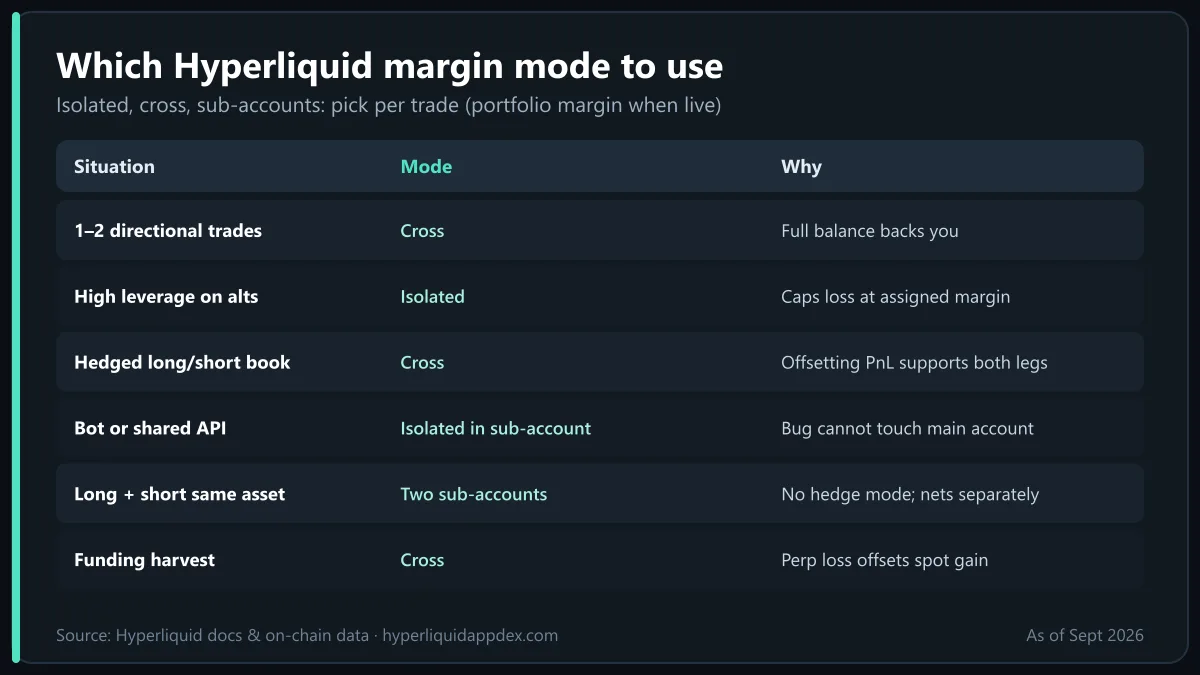
| Your situation | Recommended mode | Why |
|---|---|---|
| One or two directional trades, moderate leverage | Cross | Full balance backs you; liquidation far away |
| High leverage on an alt or new HIP-3 market | Isolated | Caps the loss at the assigned margin |
| Hedged book (long/short across correlated assets) | Cross (portfolio margin when live) | Offsetting PnL supports both legs |
| Running a bot or sharing API access | Isolated in a sub-account | Bug cannot touch the main account |
| Long and short the same asset | Two sub-accounts | No hedge mode; each account nets separately |
| Collecting funding (spot long, perp short) | Cross | Perp loss offsets spot gain; hold with low leverage |
Risk note: all margin trading can lose more than you expect in fast markets; cross margin can lose your entire perp balance. Size as if the worst case will happen.
Bottom line
You control exactly how much a trade can cost you on Hyperliquid today, even though portfolio margin is coming and not yet something to plan around: as of October 2026 you choose between isolated margin, which caps each trade's loss at its assigned collateral, and cross margin, which backs every position with your whole account value. The unified account already lets one wallet run spot, perps, staking and HyperEVM with free instant transfers, with spot-as-collateral extending gradually. There is no hedge mode and no native options, so use sub-accounts for simultaneous long and short and HyperEVM protocols for option-like payoffs. Pick the mode per trade using the table above, keep your own liquidation price far from any crowded level, and start on the Hyperliquid DEX with isolated margin until the numbers feel familiar.
Frequently Asked Questions
Does Hyperliquid have portfolio margin?
As of October 2026, portfolio margin on Hyperliquid is best described as announced and rolling out rather than fully live for all users. Hyperliquid Labs has flagged it on the roadmap and the docs reference a more capital-efficient margining of offsetting positions. Today every account uses the standard isolated or cross margin system. Check the official docs for the current status before relying on it.
What is the difference between cross margin and isolated margin on Hyperliquid?
Cross margin backs every cross position with your whole perp account balance plus unrealized PnL, so one losing trade can draw down the entire account before liquidation. Isolated margin ring-fences a fixed amount for one position; only that margin can be lost. Cross is more capital efficient, isolated is safer. See our leverage and liquidation guide.
Does Hyperliquid support hedge mode?
No. Hyperliquid uses one-way (net) positions: if you are long 1 BTC and sell 1 BTC on the same market, the position closes rather than opening a separate short. To hold long and short on the same asset at once, use a sub-account, a second wallet, or a correlated market such as a HIP-3 perp or the spot pair.
What is a Hyperliquid unified account?
Hyperliquid keeps separate perp and spot balances, but a single wallet controls both and transfers between them are instant and free. Using spot assets directly as perp collateral has been introduced for selected assets according to the docs, which is the first step toward a fully unified account. Treat full spot-plus-perp unified margin as a work in progress.
Can I trade options on Hyperliquid?
Not natively. Hyperliquid lists perpetual futures, spot, HIP-3 builder perps and HIP-4 outcome markets, but no options order book. Options exposure is available through structured-product and options protocols deployed on HyperEVM, which carry their own smart-contract risk. See the HyperEVM ecosystem guide.
How many sub-accounts can I create on Hyperliquid?
The app lets each master wallet create several named sub-accounts, each with its own perp balance, margin and positions, controlled by the master key. The exact limit can change; the docs and the app's sub-account page show the current number. Sub-accounts are the standard workaround for hedging and for separating strategies.
Ready to trade on the Hyperliquid app?
Open the official Hyperliquid DEX with our referral link and get a lifetime 4% discount on trading fees. No KYC, no gas fees, self-custody.
Open Hyperliquid App · Save 4%SIXPROSPERPaste the code in the referral field when you sign up (it must be applied before your first trade).
Disclaimer: This article is for educational purposes only and is not financial, investment or legal advice. Perpetual futures trading with leverage carries a high risk of loss. Read our full disclaimer.